Whey Protein Isolate vs. Concentrate: Is the Extra Filtration Worth the Price?
Whey isolate is marketed as the serious lifter’s protein — more filtered, more “pure,” and priced like it. The real gap between isolate and concentrate is genuine, just not where most labels point you.
Whey starts as a liquid byproduct of cheese-making, and both concentrate and isolate come from the exact same starting material. Whey concentrate is produced with a relatively light round of ultrafiltration, which leaves it around 70–80% protein by weight, with the rest made up of lactose, milk fat, and minerals. Whey isolate goes through an additional filtration step — usually microfiltration or ion-exchange — that strips out most of that remaining lactose and fat, pushing the powder to 90% protein or higher. Nothing is added to make isolate “better”; the entire process is subtractive.
Because both forms are filtered from the same liquid whey, their amino acid composition is virtually identical gram-for-gram of protein. Isolate doesn’t contain some special muscle-building compound that concentrate lacks. What differs is what’s been removed: lactose, a modest amount of fat, and some of the minor whey fractions like alpha-lactalbumin and immunoglobulins that survive the gentler concentrate process in slightly higher amounts.
That distinction matters because the marketing language around isolate leans hard on words like “purer” and “premium,” which quietly implies a performance edge that the processing itself doesn’t actually create. The honest version of this comparison is really two separate questions: does the extra filtration change what’s in the tub (yes, measurably), and does that change what the protein does in your body once you’ve matched the dose (mostly no). Those two answers get blended together in most product copy.
Who actually needs isolate
The clearest case for paying the isolate premium is lactose intolerance. Concentrate’s remaining lactose — roughly 3–4 grams per serving in a typical product — is enough to cause real GI discomfort for some people, while isolate’s lactose content drops to a gram or less per serving. If dairy already gives you trouble, this is the one scenario where the processing step buys you something you’ll actually feel.
The next tier is people counting calories or carbs tightly — someone in a cutting phase who wants 20+ grams of protein without the 3–4 extra grams of carbohydrate and a gram or two of milk fat that ride along in concentrate. It adds up over multiple servings a day, even if it’s trivial in any single scoop. Drug-tested athletes are a third group worth naming separately: isolate is the base most NSF Certified for Sport and Informed Sport products are built on, so reaching for a certified isolate is as much about the testing program behind it as the filtration itself.

How much protein actually matters here
Before picking a form, the dose question matters more than either one. A 2018 meta-analysis of 49 studies (Morton et al., British Journal of Sports Medicine, 1,863 participants) found that protein intake beyond roughly 1.6 grams per kilogram of bodyweight per day produced no further gains in fat-free mass for people doing resistance training. That’s a useful ceiling: a 75kg (165lb) lifter is generally covered around 120 grams of total daily protein from all sources, not just powder.
There’s also a persistent myth worth retiring here: the idea that the body can only “use” about 30 grams of protein in one sitting and wastes the rest. A 2018 review (Schoenfeld & Aragon, Journal of the International Society of Sports Nutrition) concludes total daily intake and how it’s spread across meals matters more than any single-meal ceiling, and excess protein isn’t discarded — it’s oxidized for energy or used elsewhere in the body. What does plateau is the muscle-building signal itself: earlier research (Moore et al., 2009) found that around 20–25 grams of high-quality protein, supplying roughly 2–3 grams of leucine, maximally stimulates muscle protein synthesis in a typical-sized adult in one sitting. A 20-gram isolate serving clears that bar on its own, and so does an equivalent-dose concentrate serving — the trigger is the leucine content of the protein, which is the same for both forms.

Isolate vs. concentrate: what actually changes
Switching from concentrate to isolate buys you a real drop in lactose and a modest drop in fat and carbs per serving, at a meaningfully higher price per gram of protein — not a documented edge in muscle growth or recovery once the protein dose is matched, since the amino acid and leucine content per gram of protein is essentially the same in both forms. The decision is really about your gut and your macros, not about which one “works better.”
What to look for in a protein powder
A few concrete checks, ordered by how often we see products fail them:
- The testing claim names a real program, not just “quality assured.” NSF Certified for Sport, Informed Sport, or Informed Choice mean an independent body screened the actual batch for label accuracy and banned substances. A brand saying it tests its own product in-house is a different, weaker claim.
- The protein-per-scoop figure matches the form on the label. An “isolate” with a suspiciously low protein number for its serving size, or a high number from a small scoop, is worth checking against the actual supplement-facts panel rather than the front-of-bag claim.
- Lactose and allergen content are disclosed, not just implied. “Low lactose” on an isolate label should be backed by an actual gram figure or a lactose-free claim you can verify, especially if you’re buying isolate specifically to avoid a reaction.
- The milk source is named, not vague. “Grass-fed,” “hormone-free,” or a named country/region of origin is a checkable sourcing claim; a label that only says “premium whey” with no origin is not.
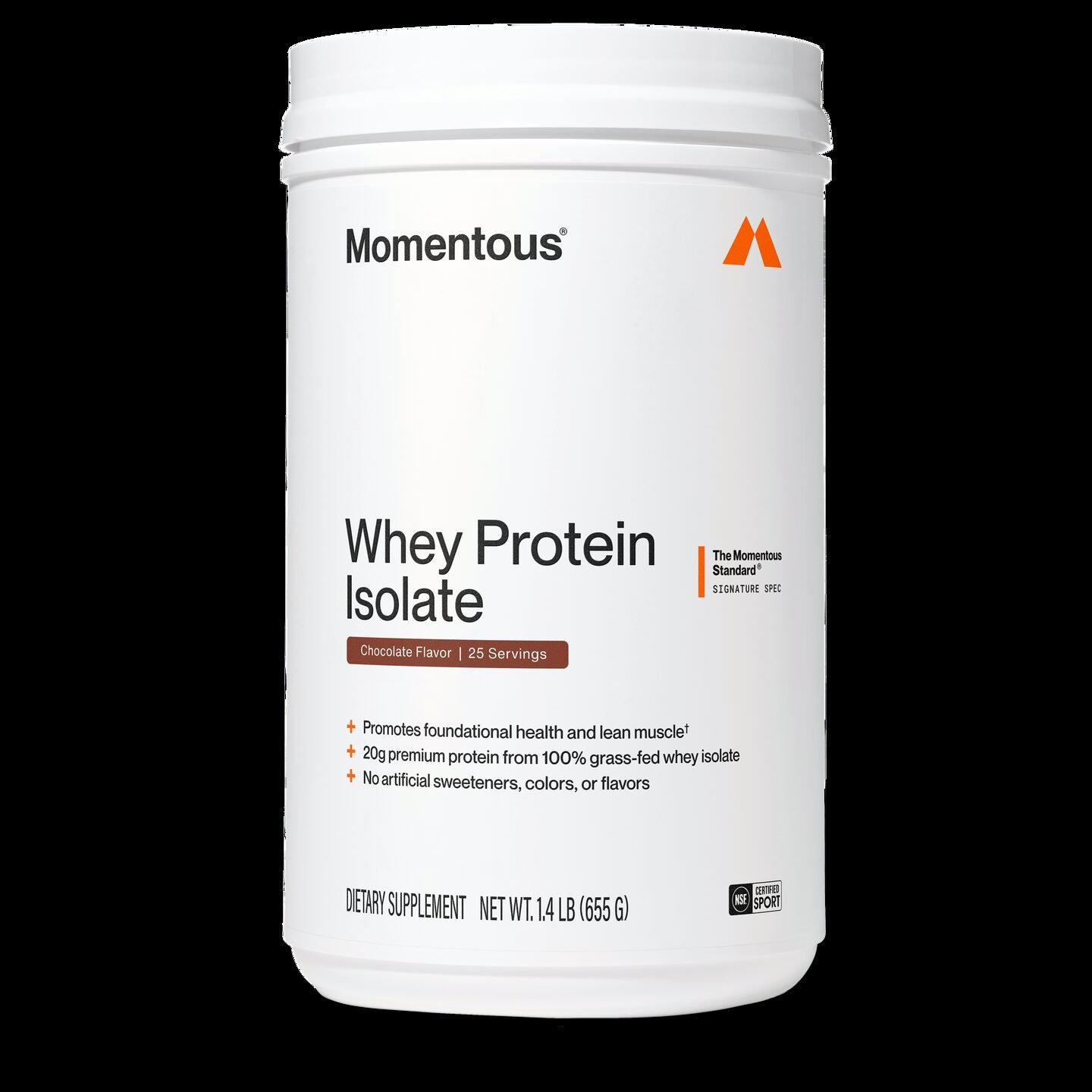
Momentous Essential Whey Protein Isolate passes the testing check twice over — it carries both NSF Certified for Sport and Informed Sport certification, a stronger pairing than most products in this category manage. It also names its source (European grass-fed dairy, hormone- and antibiotic-free) rather than leaving it vague, and its 20-gram isolate dose per scoop lines up with what’s on the supplement-facts panel. Where it doesn’t stand out is price: at roughly $2.10–$2.80 per serving depending on subscription, it’s squarely in premium-isolate territory, not a budget pick.
Dual NSF Certified for Sport and Informed Sport certification, named grass-fed European sourcing, and a label-accurate 20g isolate dose — a legitimate premium isolate, priced like one.
FAQs
Is whey isolate actually better for building muscle than concentrate?
Not in a way the research supports once the protein dose is matched. Both forms come from the same liquid whey and carry essentially the same amino acid and leucine content per gram of protein, which is what drives the muscle-building signal. Isolate’s edge is in what’s removed — lactose and fat — not in added muscle-building power.
Why is whey isolate so much more expensive than concentrate?
The extra microfiltration or ion-exchange step that removes lactose and fat is a genuinely more expensive process, and isolate also yields less finished powder per gallon of starting whey. That processing cost is passed straight through, which is why isolate commonly runs well over a dollar more per serving than a comparable concentrate.
Can people with lactose intolerance take whey concentrate at all?
Some can in small amounts — concentrate’s lactose content, typically a few grams per serving, is below what triggers symptoms for many mildly lactose-sensitive people. But if you know dairy reliably bothers you, isolate’s near-zero lactose is the safer default rather than something to test by trial and error.
Is it true the body can only use about 30 grams of protein at a time?
No — that’s an oversimplified version of a real finding. Muscle protein synthesis does show a plateau per meal, generally in the 20–25 gram range of high-quality protein for an average-sized adult, but protein eaten beyond that isn’t wasted. It’s used for energy or other processes in the body, and what matters most is your total protein across the whole day.
If lactose bothers you, you’re tracking calories tightly, or you want a product built on a drug-tested base, isolate’s premium is doing real work and is worth paying for. If none of those apply, a quality concentrate with the same third-party certification delivers the same muscle-building dose for less money.
As an Amazon Associate, The Health Verdict earns from qualifying purchases. This article is educational and is not medical advice — talk to your doctor before starting any new supplement, especially if you have kidney disease or another condition that requires managing your protein intake.