Sublingual B12 Doesn’t Absorb Better Than a Swallowed Tablet
The B12 shelf is full of lozenges, sprays and dissolving strips, nearly all of them implying that a tablet you simply swallow won’t get where it needs to go. The studies that have actually put the two routes head to head found something much less exciting: the route barely matters. The dose does.
Absorbing B12 is a two-key process, and it is unusually fussy for a vitamin. Stomach acid and pepsin first have to pry the B12 loose from the proteins it is bound to in meat, eggs and dairy. A protein called intrinsic factor, made by cells in the stomach lining, then latches onto the freed vitamin, and that pair gets carried across the gut wall by dedicated receptors near the end of the small intestine. When the system works, it is efficient: at the small amounts found in a meal, you absorb roughly half of what you take in.
What that pathway is not is roomy. Intrinsic factor can only carry so much at once, and according to the NIH Office of Dietary Supplements, absorption “decreases drastically when the capacity of intrinsic factor is exceeded” — which happens at just 1 to 2 micrograms per dose. Everything past that point has to get in some other, far less efficient way. That is the single fact that explains why B12 supplements are sold at doses hundreds of times larger than the amount you actually need.
It is also the gap the sublingual category was built to fill. The pitch is intuitive: let the tablet dissolve under your tongue and the vitamin slips straight into the bloodstream through the tissue in your mouth, skipping the stomach, the intrinsic factor bottleneck and the whole temperamental chain. It is a good story. It has simply not held up when researchers compared it against the boring alternative of swallowing the thing.
Who actually needs to supplement
B12 occurs naturally in animal foods — meat, fish, eggs, dairy — and essentially nowhere else, so vegans and vegetarians sit at the front of the risk queue by diet alone. But the larger group is people whose absorption machinery has quietly degraded. Older adults are the clearest case: stomach acid production falls with age, and atrophic gastritis is common enough that the NIH puts deficiency prevalence among community-dwelling older adults anywhere between 3% and 43%, depending on the population studied and the cutoff used. Pernicious anemia, an autoimmune condition that destroys the cells making intrinsic factor, accounts for an estimated 15% to 25% of deficiency in older adults.
Two extremely common prescriptions belong on the list too. Metformin reduces B12 absorption and can meaningfully lower blood levels over time, and acid-reducing drugs such as proton pump inhibitors interfere with freeing B12 from food in the first place. Bariatric surgery, stomach surgery, celiac disease and Crohn’s disease all cut into absorption as well. For context on the general population: in NHANES data from 2007 to 2018, about 3.6% of U.S. adults were outright deficient, while roughly 12.5% fell into the insufficient range — low enough to be worth knowing about, not low enough to have caused obvious symptoms yet.

How much B12 the research actually supports
The RDA for adults is 2.4 micrograms a day — 2.6 in pregnancy, 2.8 while breastfeeding. Set against that, the 1,000 mcg on a typical lozenge looks absurd, roughly 400 times the requirement. The absorption curve is what makes it rational. The NIH puts absorption at about 2% at a 500 mcg dose and 1.3% at 1,000 mcg. Run the arithmetic on that second figure and a 1,000 mcg tablet delivers around 13 micrograms into circulation — still more than five times the daily requirement, achieved by brute force rather than efficiency.
That inefficiency is also the safety margin. B12 has no tolerable upper intake level, because it is considered safe even at high doses, and the body simply does not retain the excess from a large dose. For a maintenance supplement, anything in the 500 to 1,000 mcg daily range clears the requirement comfortably. Correcting a diagnosed deficiency is a different exercise with different numbers, and belongs with a doctor and a blood test rather than a shelf label — particularly since total serum B12 is an imperfect marker and may need confirming with a more sensitive test.

Sublingual vs. swallowed: what changes
Less than the packaging suggests. Reviewing the comparative evidence, the NIH states plainly that “evidence suggests no difference in efficacy between oral and sublingual forms,” citing a randomised comparison of the two routes for replacement therapy published in the British Journal of Clinical Pharmacology in 2003 and a later trial measuring homocysteine. The same fact sheet adds that “no evidence indicates that absorption rates of vitamin B12 in supplements vary by form of the vitamin” — so the methylcobalamin-versus-cyanocobalamin question is a separate argument from this one, and not an absorption argument either. A useful sanity check on the whole category: a prescription intranasal B12 gel, which really does bypass the gut, lands at about 2% bioavailability for a 1,000 mcg dose, which the NIH notes is similar to an oral dose. Even genuinely skipping the digestive tract buys you roughly nothing here. What does the heavy lifting in every one of these formats is the size of the dose, not the door it comes in through.
What to look for in a B12 supplement
A few concrete checks, ordered by how often we see products fail them:
- You are not paying a premium for the delivery route. Sublingual, spray, liposomal, dissolving strip — the comparative research does not support charging more for these, and none of them rescues you from an absorption problem that the dose would not have solved anyway.
- Third-party verification of what is actually in the bottle. USP Verified or NSF marks confirm identity and potency at the product level. A certified-GMP facility audited by an outside body is a weaker but real signal. No outside verification at all is the most common failure in this aisle.
- The form is named on the label and the dose is in plain micrograms. “Methylcobalamin, 1,000 mcg” is what you want to read, not a B12 contribution hidden inside a proprietary energy blend you cannot size.
- Single ingredient, unless you specifically want more. B12 bundled with caffeine, herbal stimulants or a scattering of under-dosed B vitamins makes it impossible to tell what is doing what, and B-complex products are frequently where the B12 dose quietly drops.
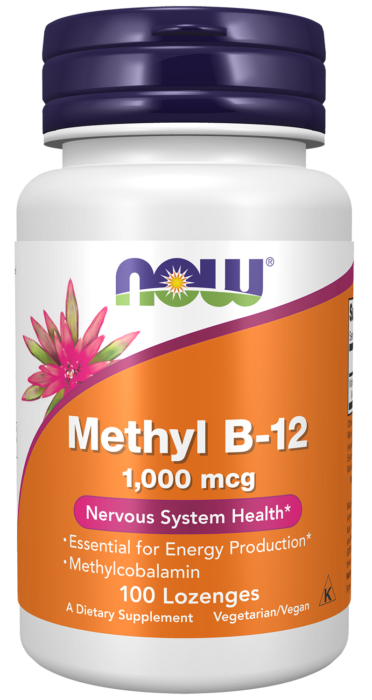
NOW’s Methyl B-12 passes three of the four cleanly: it is single-ingredient methylcobalamin, the dose is stated in plain micrograms at 1,000 mcg per lozenge, and the product carries Intertek GMP supplement certification — third-party facility auditing rather than product-level potency verification, which is the one place it gives ground to a USP Verified competitor. On the first check it is better behaved than most of the category: it is sold as a lozenge, but NOW’s own directions say to chew it or hold it in the mouth until dissolved and swallow — the company is not claiming a sublingual absorption advantage it cannot support. At roughly 13 cents a day, it is also not charging for one.
A plainly labelled single-ingredient methylcobalamin at a dose that clears the absorption ceiling with room to spare, from a third-party-audited GMP facility, at about 13 cents a day — and notably without the sublingual absorption claim the format usually invites. The deduction is for facility-level certification rather than product-level potency verification.
FAQs
So is sublingual B12 a scam?
Not a scam — just not an upgrade. Reviewing the head-to-head research, the NIH concludes there is no difference in efficacy between oral and sublingual forms. A lozenge works fine. It is worth choosing if you dislike swallowing pills or want something that is pleasant to take daily, and worth ignoring as a reason to pay more.
Why is the dose 1,000 mcg when the RDA is only 2.4 mcg?
Because the efficient absorption pathway saturates at 1 to 2 micrograms per dose, and everything beyond that gets in far less efficiently. The NIH puts absorption at about 1.3% for a 1,000 mcg dose — roughly 13 micrograms absorbed, which is still over five times the daily requirement. The large number on the label is compensating for a bottleneck, not delivering 400 days of B12.
Does methylcobalamin absorb better than cyanocobalamin?
Not according to the absorption data — the NIH states that no evidence indicates absorption rates vary by the form of the vitamin in supplements. There are other arguments made for methylcobalamin, but better absorption is not one that the evidence supports, and it should not be the reason you pay more for it.
I had bariatric surgery (or have pernicious anemia) — can I take tablets instead of injections?
That is a decision for your doctor, with blood monitoring. The evidence is genuinely encouraging: a Cochrane review examined three trials totalling 153 participants and found high oral doses of 1,000 to 2,000 mcg normalised serum B12 about as well as intramuscular injections, though it rated the evidence low quality, and 1,000 mcg daily oral methylcobalamin has looked comparable to injections after gastric bypass. Injections remain the standard first-line treatment, so this is a conversation to have, not a swap to make on your own.
If you eat little or no animal food, are past about 60, or take metformin or a daily acid reducer, a cheap 1,000 mcg B12 is one of the easier supplements to justify — and you can buy whichever format you will actually take every day, because the research says the format is not what decides the outcome. If you suspect you are already deficient, that is a blood test and a doctor’s plan, not a shelf decision.
As an Amazon Associate, The Health Verdict earns from qualifying purchases. This article is educational and is not medical advice — talk to your doctor before starting any new supplement, especially if you are being treated for a diagnosed B12 deficiency or pernicious anemia, where supplementing on your own can mask a problem that needs monitoring.