Protein Spiking Is Still Legal — Here’s How to Tell If Your Powder Does It
Read enough protein powder labels and the math stops adding up: some tubs claim 25 grams of protein per scoop from an ingredient list that could not reasonably deliver it. There is a name for how that happens, and it is still completely legal.
The trick is called amino spiking (or protein spiking), and it exploits how protein content actually gets measured. Most labels are based on a nitrogen test — Kjeldahl or Dumas combustion — that counts total nitrogen in the powder and multiplies by a standard conversion factor to estimate “protein.” The test cannot tell the difference between nitrogen from real, intact whey protein and nitrogen from cheap free-form amino acids like glycine, taurine, or glutamine dumped in by the spoonful. Add enough of those, and a formula that is genuinely light on whey can still print a big number on the label without breaking any labeling law.
Why does the distinction matter for your body? Muscle protein synthesis (MPS) — the process that actually repairs and builds tissue after training — is not triggered by nitrogen in the abstract. It is triggered by intact protein delivering a full spread of essential amino acids in the right ratios, with leucine acting as the primary “on switch.” Free-form glycine and taurine are cheap, harmless in small amounts, and nutritionally almost irrelevant to that process. A scoop that is heavy on them and light on real whey can hit the same gram count on paper while doing noticeably less work in your muscles.
This is exactly the gap that meaningful third-party testing closes. NSF Certified for Sport is the strictest widely available program: alongside screening for roughly 270 banned substances, it requires label claims — including protein content — to be independently verified against what is actually in the tub. A powder carrying that mark has had its protein math checked by someone other than the company selling it.
Who actually needs this
Protein powder earns its place for a specific set of people: anyone training with resistance three or more times a week, anyone who has actually tracked their food and found they fall well short of their target most days, and older adults, who need more protein per meal than younger lifters to trigger the same muscle-building response — a phenomenon researchers call anabolic resistance.
It is worth being honest about who does not need it. If your diet already comfortably covers your protein target through chicken, eggs, dairy, and legumes, a scoop of isolate is not doing something whole food cannot — its real advantage is convenience and fast digestion around a workout, not some unique muscle-building property food lacks. Powder is a tool for hitting a number you are otherwise missing, not an upgrade over food you are already eating enough of.

How much protein — and how often
Total daily intake matters more than any single scoop. For people actively training for muscle growth or strength, the sports-nutrition research base generally supports 1.6–2.2 grams of protein per kilogram of bodyweight per day — well above the standard 0.8 g/kg RDA, which is a minimum to prevent deficiency, not a target for anyone trying to add muscle. A 175-pound (80 kg) lifter aiming for that range is looking at roughly 128–176 grams a day, spread across meals.
Per serving, research on the muscle-protein-synthesis response points to a sweet spot of about 20–40 grams of high-quality protein per sitting, with the leucine threshold — roughly 2.5–3 grams of leucine — being the specific amount needed to meaningfully flip the MPS switch in a single meal. Whey isolate is unusually leucine-dense per gram, which is a real part of why it became the reference standard in this research rather than just a marketing talking point. Older adults tend to need doses at the higher end of that range, closer to 40 grams, to get the same response a younger lifter gets from 20.

Whey isolate vs. whey concentrate: what changes
Isolate is filtered further than concentrate, landing around 90%+ protein by weight with most of the lactose and fat stripped out, which is why it tends to sit better with lactose-sensitive stomachs and digests slightly faster. Concentrate typically runs 70–80% protein, retains a few more of the bioactive compounds naturally present in whey, and usually costs less per serving. Once you are hitting an effective per-serving dose, the difference in actual muscle-building outcome between the two forms is small — the meaningful gap is digestive tolerance and, increasingly, which one is more likely to be paired with real testing rather than raw protein-building superiority.
What to look for in a protein powder
A few concrete checks, in order of how often we see products fail them:
- Third-party testing that verifies content, not just banned substances. NSF Certified for Sport and Informed Sport both check that the protein claim on the label matches what is actually in the tub — a much higher bar than a company’s own in-house lab result.
- No amino spiking. Check the ingredient list for free-form glycine, taurine, or glutamine listed high up relative to whey protein isolate or concentrate — that ordering is the tell that a formula is padding its nitrogen count.
- Minimal additives. Gums, artificial sweeteners, and filler ingredients are common in budget tubs and add nothing to the protein’s effectiveness; a short, recognizable ingredient list is a good proxy for a formula that is not compensating for something.
- Sourcing and processing disclosed. Grass-fed, hormone-free dairy that is cold-processed and micro-filtered preserves more of whey’s natural amino acid and bioactive profile than heat-processed, generic-sourced whey.
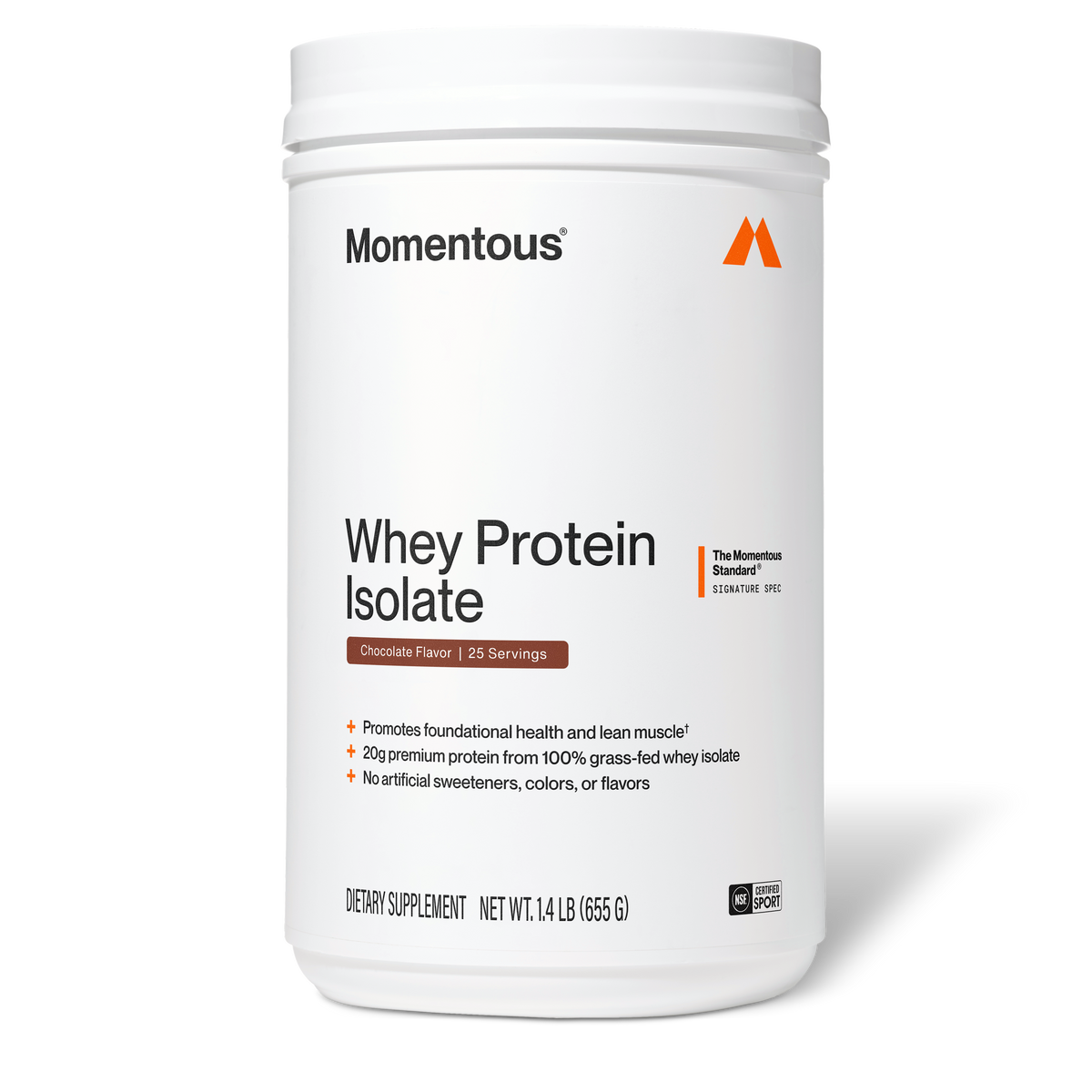
This is exactly what we found in Momentous Essential Grass-Fed Whey Protein Isolate: NSF Certified for Sport with the label claims independently verified, a short ingredient list with no free-form amino padding, and whey sourced from European grass-fed dairy that is cold-processed and micro-filtered rather than heat-treated.
NSF Certified for Sport with independently verified protein content, no amino-spiking padding, and grass-fed, cold-processed sourcing at a real 20g-per-scoop dose — one of the few tubs on the shelf that can actually back up its label.
FAQs
Is whey protein isolate always better than whey protein concentrate?
Not automatically — isolate has less lactose and fat and digests a bit faster, which matters most if you are lactose-sensitive or want something fast-absorbing around a workout. For overall muscle-building outcome, an effective dose of either form works; the bigger factor is whether the product is actually tested and free of amino spiking.
How do I actually spot amino spiking on a label?
Check the ingredient list order, not just the protein-per-scoop number. If free-form glycine, taurine, or glutamine appear before or immediately after the whey protein isolate/concentrate itself, that is a sign those cheaper amino acids make up a meaningful share of the total. A short, whey-forward ingredient list with third-party certification is the more reliable check.
Do I need protein powder if I already eat enough protein from food?
No — if you are consistently hitting your daily protein target through whole food, a supplement is not adding a unique benefit. It becomes genuinely useful when it closes a real gap: a busy morning, a long gap between meals, or the convenience of fast-digesting protein right after a workout.
Is NSF Certified for Sport different from a generic “third-party tested” claim?
Yes, and the difference is meaningful. “Third-party tested” on its own is an unregulated marketing phrase that can mean almost any level of scrutiny. NSF Certified for Sport is a specific, audited program that screens for roughly 270 banned substances and verifies that label claims, including protein content, match what is actually in the product.
If you train regularly and have actually tracked your food and come up short of your protein target most days, a tested isolate like this is worth adding. If your diet already covers it, save the money and put it toward the food itself.
As an Amazon Associate, The Health Verdict earns from qualifying purchases. This article is educational and is not medical advice — talk to your doctor before starting any new supplement, especially if you have kidney disease or another condition that affects how your body processes protein.