Nicotinamide Riboside Raises Your NAD+ — Here’s What It Quietly Costs Your Methylation Reserves
A 2023 clinical trial pushed nicotinamide riboside to 3,000 milligrams a day and found something most product pages never mention: the same dose that reliably raises NAD+ also nudges a blood marker tied to the body’s supply of methyl groups. The effect was mild. It was also real, measured, and published — and it points to a tradeoff almost no NAD+ label discloses.
NAD+ (nicotinamide adenine dinucleotide) is a coenzyme every cell needs to run its energy metabolism, and it also fuels two separate families of repair enzymes: sirtuins, which regulate gene expression and stress response, and PARPs, which patch broken DNA. Both processes consume NAD+ as they work, and by most measurements the body’s NAD+ pool declines with age — one widely cited estimate puts midlife levels at roughly half of what they were in youth. That decline is the premise behind an entire supplement category built around NAD+ “precursors,” molecules the body can convert into NAD+ more efficiently than taking NAD+ itself, which barely survives digestion intact.
Nicotinamide riboside (NR) is one of two precursors that dominate that category, the other being nicotinamide mononucleotide (NMN). NR gets absorbed through a dedicated transporter, converted to NMN inside the cell, and then to NAD+ — a shorter path than the one dietary niacin takes, and one that doesn’t trigger the skin flushing older niacin forms are known for. A 2016 human trial, the first to test NR directly, gave twelve healthy adults single doses of 100, 300, or 1,000 milligrams and tracked their blood NAD+ metabolome afterward. The increase was dose-dependent, and no participant reported serious side effects at any dose — a reasonable bar clearing that got the ingredient taken seriously.
What that first trial didn’t examine was what happens on the other side of the reaction. When cells finish using NAD+, the leftover nicotinamide has two possible fates: get recycled back into more NAD+, or get cleared from the body by an enzyme called nicotinamide N-methyltransferase (NNMT), which tags it with a methyl group borrowed from the body’s SAM pool — the same methyl-donor reserve used for dozens of other jobs, from neurotransmitter synthesis to detoxification. Push more nicotinamide through that clearance pathway, as a steady NR habit does, and you’re asking the methyl-donor pool to do more work.
Who Actually Needs This
NR supplementation is aimed at adults who want to support an NAD+ pool they expect is declining with age, typically starting somewhere in the 40s or 50s, or anyone training hard enough that cellular energy turnover is a real bottleneck. It is not a treatment for a diagnosed condition, and the research base — while more developed than most longevity supplements — still consists mostly of short trials measuring blood NAD+ and safety markers, not hard endpoints like disease risk or lifespan.
It’s a poor fit for anyone already dealing with a methylation-related issue: unmanaged high homocysteine, a known MTHFR-related methylation disorder, or low B12/folate status that hasn’t been corrected yet. People on methotrexate, which also interferes with methyl-group and folate metabolism, should talk to the prescribing doctor before adding NR. Pregnant or nursing women should skip it, since none of the human trials below enrolled that population.

The Dose That Actually Raises NAD+ — And What It Costs
Repeat dosing is where the picture firms up. A 2017 randomized, double-blind, placebo-controlled trial gave 120 adults aged 60–80 either placebo or NR combined with pterostilbene for eight weeks, at two dose levels. The lower dose (250 mg NR daily) raised whole-blood NAD+ by roughly 40 percent, sustained through day 60. The higher dose (500 mg NR daily) raised it by roughly 90 percent at day 30, settling to about 55 percent above baseline by day 60 — still well above the lower arm. Adverse events were mild and statistically no different from placebo, which is the strongest safety signal NR has going for it at these doses.
The methylation cost shows up at the extreme end. A 2023 trial in Parkinson’s patients pushed NR to 3,000 milligrams daily — six times the higher dose above — for four weeks. Serum homocysteine rose by about 1.7 micromoles per liter versus baseline, a small but statistically significant shift, while whole-blood homocysteine stayed flat. Betaine levels dipped slightly in the NR group. The authors’ own conclusion was reassuring: this did not amount to a depletion of the methyl-group pool, and no participant developed symptoms tied to it. But the fact that a measurable signal showed up at all, in exactly the pathway the NNMT mechanism predicts, is the honest version of the story — one that gets smoothed over by marketing copy that treats NAD+ precursors as having no metabolic cost whatsoever.

NR Alone vs. NR + a Methyl Donor: What Changes
Plain nicotinamide riboside, taken at the 250–500 mg range with repeat-dose evidence behind it, reliably raises NAD+ on its own — the mechanism doesn’t require anything else to work. What a methyl donor like betaine (trimethylglycine) changes is the other side of the ledger: it replenishes the same pool that NNMT draws from to clear nicotinamide, directly addressing the one documented metabolic cost of raising nicotinamide flux, rather than leaving a user to source that from diet alone and hope it’s enough. A 2023 review of NAD+-boosting combinations put it plainly: concurrent methyl-donor supplementation “may prevent the proposed decline” tied to NAD+ precursor use. It isn’t a required pairing — the Parkinson’s trial above found the unsupplemented methyl pool held up fine even at six times the standard dose — but it’s a reasonable hedge, and a nearly free one to build into a formula.
What to Look For in an NAD+ Product
This category has more marketing noise than most. Here’s what actually separates a defensible NR product from a label riding the trend:
- A repeat-dose human trial behind the ingredient, not just a single-dose bioavailability study. Plenty of NAD+ marketing cites the 2016 first-in-human trial and stops there. The 2017 repeat-dose data at 250–500 mg is the evidence that actually supports a daily supplement habit, and it’s worth checking whether a product’s dose falls anywhere near that studied range.
- A clearly disclosed elemental dose, not just a salt-form weight. Nicotinamide riboside is sold as several different salts — chloride, and newer forms like hydrogen malate — and a label listing “415 mg Nicotinamide Riboside Hydrogen Malate” with no separate elemental-NR figure makes it harder to compare against the doses used in research, even when the ingredient itself is legitimate.
- A built-in methyl donor or an explicit acknowledgment that one helps. Most plain NR capsules skip this entirely, leaving the one documented metabolic cost of the ingredient unaddressed. Betaine (trimethylglycine) is the most common and well-studied choice.
- Independent testing for identity, potency, and purity. NAD+ precursors are chemically unstable in some formulations, so a verification that the bottle contains what the label says — not just a manufacturing-facility certification in the abstract — is worth confirming before paying a premium price.
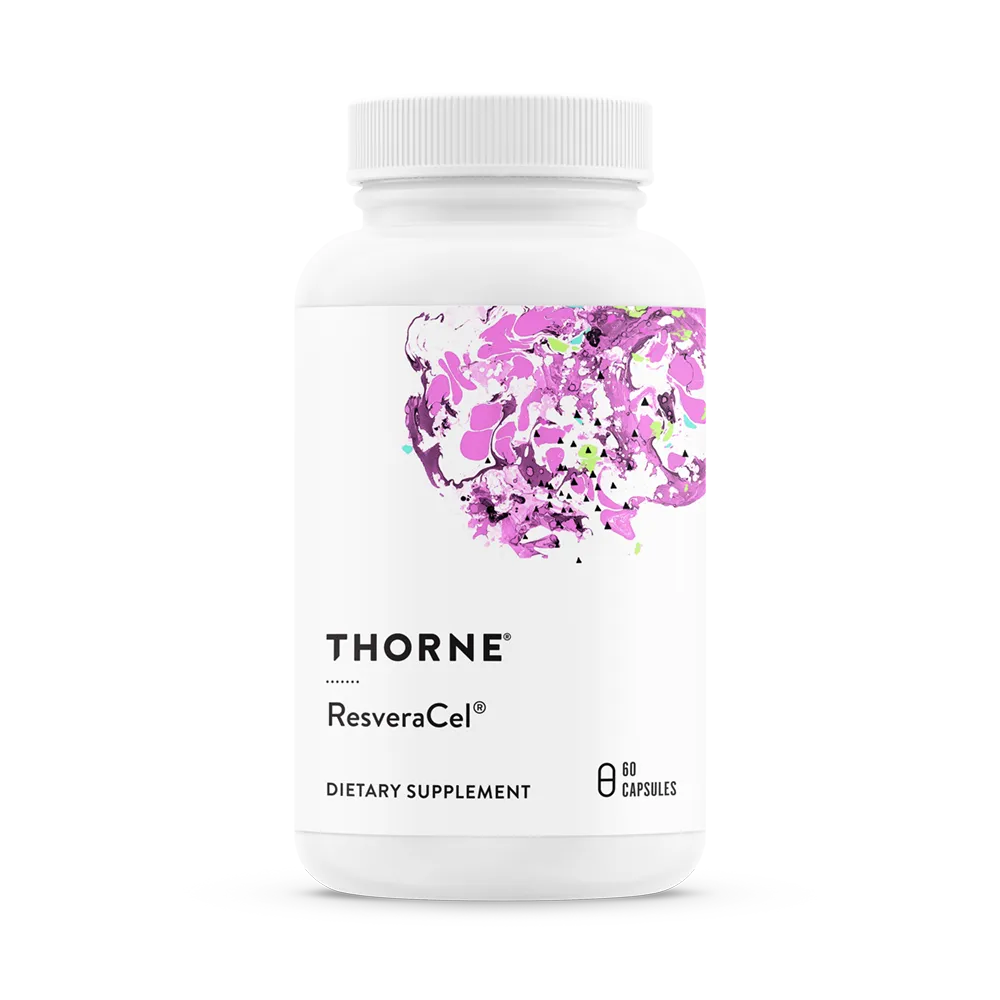
Thorne’s ResveraCel passes most of this list cleanly: its 415 mg nicotinamide riboside hydrogen malate dose sits in a defensible range relative to the repeat-dose research, and it’s one of a small number of combination products that actually builds in a methyl donor — 85 mg of betaine anhydrous — alongside quercetin and trans-resveratrol. It loses a point for not disclosing an elemental-NR equivalent on the label, and for carrying no product-specific third-party certification of its own (Thorne’s Certified for Sport line covers a different NR product, not this one).
A thoughtfully built NR formula that’s one of the few in its category to address the ingredient’s documented methylation cost head-on, docked for an undisclosed elemental dose and no product-specific third-party certification.
FAQs
Does nicotinamide riboside cause the flushing niacin is known for?
No — that’s actually one of its selling points. The 2016 first-in-human trial tested single doses up to 1,000 mg and reported no flushing, unlike nicotinic acid (a different niacin form), which reliably causes it. NR takes a different absorption and metabolic path than nicotinic acid, which is the mechanistic reason for the difference.
Do I need a separate betaine or TMG supplement if my NR product doesn’t include one?
Not necessarily. The strongest human safety data on this, a 2023 trial at six times the typical dose, found the methyl-donor pool held up without any added betaine. It’s a reasonable hedge to include or add one, especially at higher NR doses, but the evidence doesn’t show it as a requirement at standard 250–500 mg amounts.
How long before an NR supplement raises NAD+?
The repeat-dose trial showed a significant rise in whole-blood NAD+ by the first measured timepoint, 30 days, and it held through day 60 of daily dosing. Single-dose human data shows blood changes within hours, but a stable, repeat-dosing increase is the more relevant number for anyone taking it daily.
Is a much higher dose, like 1,000–3,000 mg, better than the standard 250–500 mg range?
Not based on current evidence. The repeat-dose trial found the higher of its two studied doses (500 mg) didn’t sustain its peak advantage as well as expected by day 60, and the only trial testing 3,000 mg was a closely monitored clinical study in a specific patient population, not a general recommendation. Sticking near the 250–500 mg range with published repeat-dose data is the more defensible choice outside of medical supervision.
Anyone already managing a methylation-related condition, taking methotrexate, or dealing with unexplained elevated homocysteine should talk to their doctor before starting NR, with or without a methyl donor included. For everyone else considering an NAD+ precursor as a general healthy-aging supplement, a formula that’s transparent about dose and actually accounts for the one documented metabolic tradeoff is a more defensible starting point than a bare NR capsule riding the trend.
As an Amazon Associate, The Health Verdict earns from qualifying purchases. This article is educational and is not medical advice — talk to your doctor before starting any new supplement, especially if you take methotrexate or manage a methylation-related condition.