MK-4 vs. MK-7: Why Most Vitamin K2 Labels List a Dose That Never Reaches Your Blood
A 2012 pharmacokinetic study found that one form of vitamin K2, taken at a typical “nutritional” dose, never showed up in the bloodstream of a single test subject — while the other form did, for two full days. Most multivitamins and bone-health supplements don’t disclose which one you’re getting, or at what dose.
Vitamin K’s job in the body is to activate a small set of proteins through a chemical step called carboxylation — without it, those proteins are produced but functionally useless. Osteocalcin, the protein that helps direct calcium into bone, needs carboxylation to work. So does matrix Gla protein (MGP), which keeps calcium out of artery walls. So do the liver’s clotting factors, which is the one job vitamin K is famous for and the reason it ended up on nutrition labels in the first place.
Vitamin K1 (phylloquinone), the form in spinach, kale, and other leafy greens, is extremely good at the clotting-factor job and comparatively bad at reaching bone and arteries. Research going back two decades has shown K1 is preferentially shuttled to the liver and cleared from circulation quickly, leaving little for the “extrahepatic” tissues — bone, arterial wall, cartilage — that depend on a steadier supply. That gap is what vitamin K2 supplements are sold to fill. But “K2” isn’t one thing: it’s a family of menaquinones, and the two that show up in supplements, MK-4 and MK-7, behave so differently in the body that lumping them together on a label is close to meaningless.
The difference comes down to a side chain. MK-4 has a short isoprenoid tail, similar in length to K1’s; MK-7’s tail is roughly twice as long. That length changes how tightly each molecule binds to the lipoproteins that ferry it through the bloodstream. MK-7 hitches a long, slow ride on triglyceride-rich lipoproteins and keeps circulating for days. MK-4 is cleared in a matter of hours — closer to K1’s profile than to MK-7’s. The practical result, confirmed directly in human blood draws rather than just inferred from chemistry, is that a “nutritional” dose of MK-4 can fail to register in serum at all, while the same-sized dose of MK-7 is still detectable two days later.
Who Actually Needs More Vitamin K2
Most people eating a normal diet get enough vitamin K1 to keep clotting factors working — that’s the easy threshold K1 was designed to meet, and deficiency is rare outside of malabsorption conditions, certain antibiotics, or liver disease. The harder threshold is the extrahepatic one: whether bone- and artery-protecting proteins like osteocalcin and MGP are getting carboxylated, not just produced. That’s a separate question diet doesn’t reliably answer, because the main dietary source of MK-7 is natto — fermented soybeans — which most people outside Japan never eat, and the main dietary sources of MK-4 (egg yolk, certain cheeses, liver) deliver it in amounts far below what research has used to test an effect.
People most likely to benefit from a deliberate K2 supplement include postmenopausal women managing bone density, anyone on long-term calcium or vitamin D supplementation (which increases calcium available for bone or arteries to use, but doesn’t direct it), and people with cardiovascular risk factors who are specifically interested in arterial calcification biology. It is not a substitute for prescribed osteoporosis treatment or a reason to stop a cholesterol or blood pressure medication, and anyone on an anticoagulant needs to read the dosing section below before touching either form.

The Dose That Actually Shows Up In Blood
The clearest head-to-head evidence comes from a 2012 trial in Nutrition Journal (Sato, Schurgers & Uenishi) that gave healthy women either MK-4 or MK-7 and tracked serum levels directly. In the single-dose arm, both forms were given at 420 micrograms — a dose about seven times the recommended intake. MK-7 reached its highest measured serum level at 6 hours and was still detectable 48 hours later. MK-4, at the exact same 420-microgram dose, was not detectable in any subject at any time point, from 2 hours to 72 hours. In a second arm testing a week of daily dosing at 60 micrograms — roughly the RDI — serum MK-7 rose significantly; serum MK-4 did not move at all. The authors concluded plainly that “MK-4 has a poor bioavailability at a nutritional level dose, whereas MK-7 is well absorbed,” and that the two forms “should be differentiated with regard to bioavailability and efficacy” rather than treated as interchangeable.
That doesn’t mean MK-4 is useless — it means the dose has to be much higher to matter. The same paper, citing earlier work, puts the threshold above 420–500 micrograms just to begin registering in blood, and Japan’s approved osteoporosis drug formulation of MK-4 uses 45 milligrams a day — roughly 1,000 times the amount most U.S. “multi-K” supplements list as their MK-4 content. A label that lists “Vitamin K2 (as MK-4) 45 mcg” in a microgram amount is, per this data, not supplying a dose with a plausible shot at reaching circulation. MK-7 doesn’t have that problem: because it’s cleared so slowly, microgram-range doses in the 45–180 mcg range — the range used in most human K2 research — are enough to raise and hold serum levels.

MK-7 Alone vs. MK-7 + a Real Dose of MK-4: What Changes
A product built around MK-7 alone covers the extrahepatic job that the Sato data actually supports — steady circulating K2 for bone and arterial Gla-protein activation — at a dose proven to move serum levels. A product that also lists MK-4 only adds something if that MK-4 is dosed in milligrams, not micrograms; otherwise it’s a marketing line with no measurable effect behind it. A formula that pairs MK-7 at 90 mcg with MK-4 at 5 milligrams isn’t trying to replace the Japanese drug-level dose (45 mg), but it’s a meaningfully larger amount than the token microgram quantities most competitors print, and it’s consistent with the direction the bioavailability research points — MK-4 needs to be dosed like it’s trying to do something, not like it’s an afterthought on a label.
What to Look For in a Vitamin K2 Product
Most vitamin K2 products fail on dose disclosure before they fail on anything else. Here’s what separates a label worth trusting from one that’s just checking a box:
- MK-7 dosed at 45–180 mcg. This is the range used in the human studies that actually found an effect on circulating K2 and downstream carboxylation. A product with “K2” buried in a proprietary blend at an undisclosed amount, or dosed under 45 mcg, is the most common way this category shortchanges buyers.
- MK-4, if present, dosed in milligrams — not micrograms. Per the Sato 2012 data above, a microgram-range MK-4 dose was undetectable in blood at seven times the RDI. A label listing “MK-4” in micrograms is listing an ingredient with no demonstrated path to doing anything.
- Independent content verification, correctly understood. A seal confirming the label’s stated amounts were independently verified (for example, NSF/ANSI 173 content certification) is a real and useful check. It is not the same claim as NSF Certified for Sport, which screens for banned athletic substances — don’t let one stand in for the other when you’re comparing products.
- Clear sourcing and interaction warnings. MK-7 in supplements is almost always fermentation-derived (typically via Bacillus subtilis, the same bacteria used to make natto) rather than synthetic, and that should be stated. Just as important: any vitamin K1 content on the label needs to be visible, because it’s the ingredient most relevant to anyone on an anticoagulant.
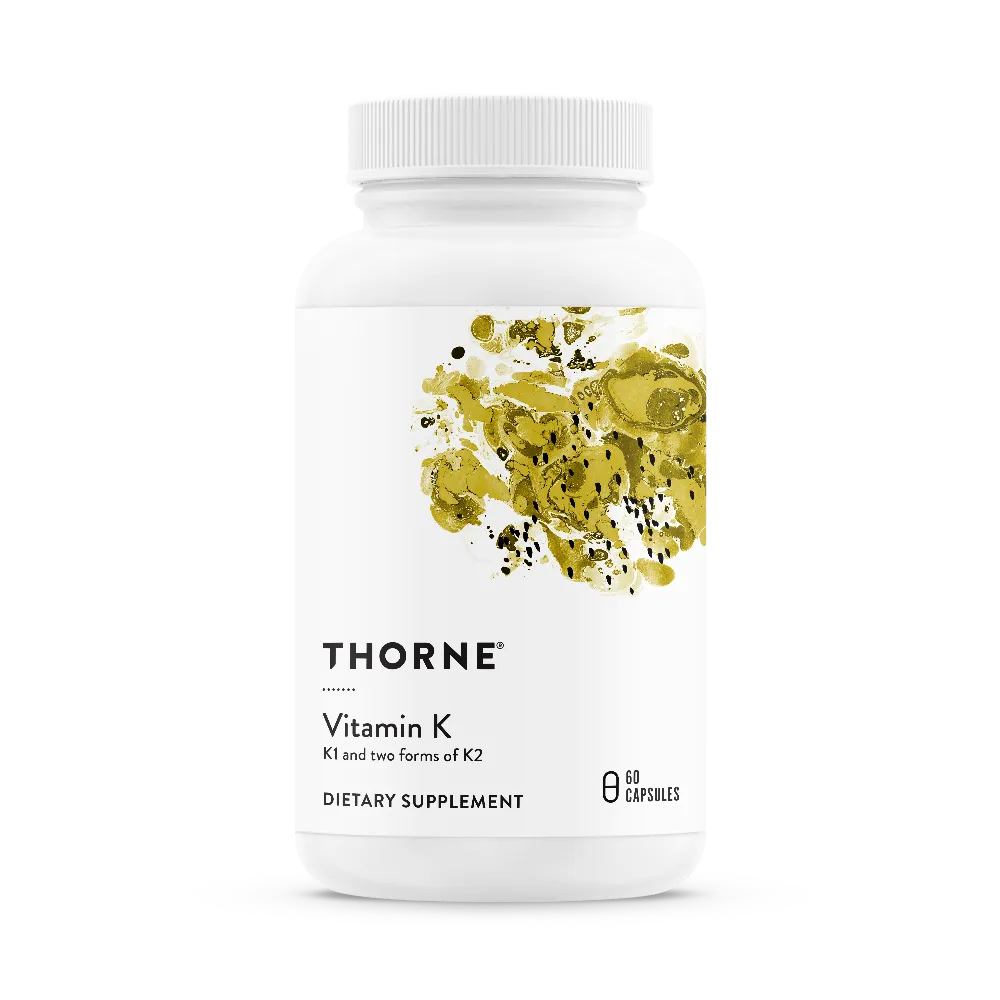
Thorne’s Vitamin K passes on all four: 90 mcg of MK-7 (inside the effective range), 5 mg of MK-4 (a real dose, not a token one), NSF content-verification rather than an unverifiable in-house claim, and a label that discloses a full milligram of K1 alongside both K2 forms rather than hiding it.
A genuinely differentiated three-form formula — K1, MK-4 at a real milligram dose, and MK-7 at a research-matched 90 mcg — with independently verified label content, docked for its substantial K1 load and a price that runs well above most single-form K2 products.
FAQs
Is MK-7 simply a “better” version of MK-4, or do they do different jobs?
They’re not interchangeable, but the practical issue isn’t which job each does — it’s dose. At the microgram amounts most supplements use, MK-4 doesn’t reliably reach circulation at all, per direct blood-serum testing. MK-7 does, at the same or lower doses, because it’s cleared far more slowly. For daily supplementation aimed at bone and arterial Gla-protein activation, MK-7 is the form with a demonstrated path to actually raising blood levels.
How much MK-7 do I actually need?
Most human studies that found an effect on circulating K2 status used between 45 and 180 micrograms of MK-7 per day. Thorne’s capsule provides 90 mcg, inside that range. More isn’t automatically better here — there isn’t strong evidence that doses far above 180 mcg add meaningful benefit for most people.
Can I get enough vitamin K2 from food instead of supplementing?
For MK-7, realistically only if you eat natto regularly, since it’s the one food that supplies it in meaningful amounts — and it’s an acquired taste most people outside Japan don’t eat. Egg yolk, certain aged cheeses, and liver carry some MK-4, but at normal serving sizes that amount is far below what research has used to detect a serum effect, so food alone is an unreliable way to hit a therapeutic MK-4 dose.
Is it safe to take a vitamin K2 supplement if I’m on blood thinners like warfarin?
Not without talking to the doctor managing your anticoagulation first. Warfarin works by blocking vitamin K activity, and any form of vitamin K — K1 or K2 — can blunt that effect and shift your INR. This particular product also contains a full milligram of K1, which is a clinically relevant amount. Don’t start or stop it without your prescriber knowing, and don’t adjust your own dose based on how you feel.
If you’re already taking calcium and vitamin D for bone density, or you’re specifically trying to support arterial Gla-protein activation rather than just hitting an RDI number, a K2 product that discloses real doses of both forms — not a vague “vitamin K2 blend” — is worth the switch. If you’re on warfarin or another vitamin K antagonist, this is a conversation for your prescribing doctor before it’s a purchase decision.
As an Amazon Associate, The Health Verdict earns from qualifying purchases. This article is educational and is not medical advice — talk to your doctor before starting any new supplement, especially if you take warfarin or another blood-thinning medication.