Immediate-Release vs. Extended-Release Melatonin: Why the Form You Take Decides Whether You Fall Asleep or Stay Asleep
Most people treat melatonin like a single thing you either take or don’t — but the form matters more than the brand, because plain melatonin usually clears your bloodstream within an hour or two of swallowing it, long before a full night’s sleep is over.
Melatonin is a hormone, not a sedative. Your pineal gland starts releasing it as darkness falls, it binds MT1 and MT2 receptors in the brain’s suprachiasmatic nucleus, and it tells the rest of your body “it is biological night” — a timing signal, not a knockout dose. In a person with normal circadian rhythm, that signal isn’t a spike. It’s a curve: levels start climbing around 9 or 10 p.m., peak somewhere between 2 and 4 a.m., and taper off toward morning as cortisol takes back over.
Oral melatonin supplements don’t match that curve by default. Depending on the dose and study, melatonin’s elimination half-life runs somewhere around 20 to 50 minutes, and the liver clears most of a standard dose fast via first-pass metabolism. A plain immediate-release tablet taken at bedtime typically has blood levels falling back toward baseline within an hour or two — plenty of time to nudge you toward sleep onset, but gone well before 3 a.m.
That mismatch is the whole story behind why some people swear melatonin works and others say it “stopped doing anything” around hour four. It isn’t that melatonin failed. It’s that insomnia isn’t one problem, and a fast-in-fast-out dose was only ever built to solve one half of it.
Who Actually Needs Extended-Release
Sleep-onset insomnia — lying awake unable to drift off — is the problem immediate-release melatonin was designed for, and it’s reasonably well matched to the job: a quick rise in blood melatonin close to bedtime, mimicking the start of your own evening curve, helps cue the brain toward sleep. This is also the version most jet-lag and shift-work protocols use, because the goal there is shifting the timing signal, not sustaining it.
Sleep-maintenance insomnia — falling asleep fine, then waking at 2 or 3 a.m. and lying there — is a different mechanism, and it’s the one plain immediate-release melatonin is poorly suited to fix, because by 3 a.m. the dose taken at 10 p.m. is long gone. This is also the pattern most associated with aging: endogenous melatonin production declines over the decades, and the prescription prolonged-release melatonin used in Europe for insomnia in adults over 55 (brand name Circadin, a 2 mg tablet) was specifically designed and studied to replace that lost overnight curve rather than just speed up sleep onset.

The Dosing Research Most Labels Ignore
There’s a persistent assumption that more melatonin means a stronger effect, and the research doesn’t really back that up. Some of the earliest controlled dosing work, including studies out of MIT in the late 1990s and early 2000s, found that very low doses — around 0.3 mg — produced sleep-promoting effects comparable to doses ten times larger, consistent with melatonin receptors behaving more like a switch that saturates at a low concentration than a dial you keep turning up. Many bottles on shelves sell 5, 10, even 20 mg per capsule, doses far above what most trial data has actually tested for added benefit, and higher doses are more consistently linked to next-day grogginess.
That argues for a different kind of product than “as much melatonin as the bottle can legally hold.” A modest total dose, split so an initial fraction handles onset and a slower-dissolving fraction extends coverage for several more hours, is a closer match to both the dosing research and the body’s own secretion curve than either a bare-bones 3 mg immediate-release tablet or a 10 mg megadose.

Immediate-Release Alone vs. IR + Extended-Release: What Changes
Swapping a single fast-clearing dose for a two-phase capsule doesn’t change what melatonin does biologically — it changes when it’s available. The immediate-release fraction still gives you the same early signal toward sleep onset; the extended-release fraction is the part that’s actually new, dissolving more slowly so measurable melatonin is still present several hours later, during the stretch of the night when sleep-maintenance insomnia tends to strike and a plain tablet has already cleared out.
What to Look For in a Melatonin Product
A few concrete checks, ordered by how often products in this category fail them:
- The dose sits in the range dosing research actually supports. Most of the controlled trial data behind melatonin’s sleep effects clusters between roughly 0.3 mg and 3 mg — a label advertising 10 mg or 20 mg “extra strength” is marketing a number, not a better-studied dose, and higher amounts are more often linked to morning grogginess than to a meaningfully better night’s sleep.
- “Extended release” is explained, not just printed on the front. A real two-phase or prolonged-release formulation should be able to describe roughly how long release is sustained and why; a bottle that just adds the words “time release” to a standard tablet without any delivery-technology detail is making a claim the capsule itself may not back up.
- Independent testing on the specific product, not just a facility-level GMP claim. Melatonin content has a documented history of drifting from label claims in testing going back to the early 2000s, and a manufacturing-process certificate alone doesn’t confirm what’s actually in a given bottle — look for a manufacturer that is NSF GMP registered and backs potency claims with its own identity and purity testing, not marketing copy alone.
- No sprawling “sleep blend” hiding the melatonin dose. Plenty of products bury a small, often-unstated melatonin amount inside a long list of herbal extras at trace doses. A single-ingredient product lets you actually control and track the one variable you’re trying to test on yourself.
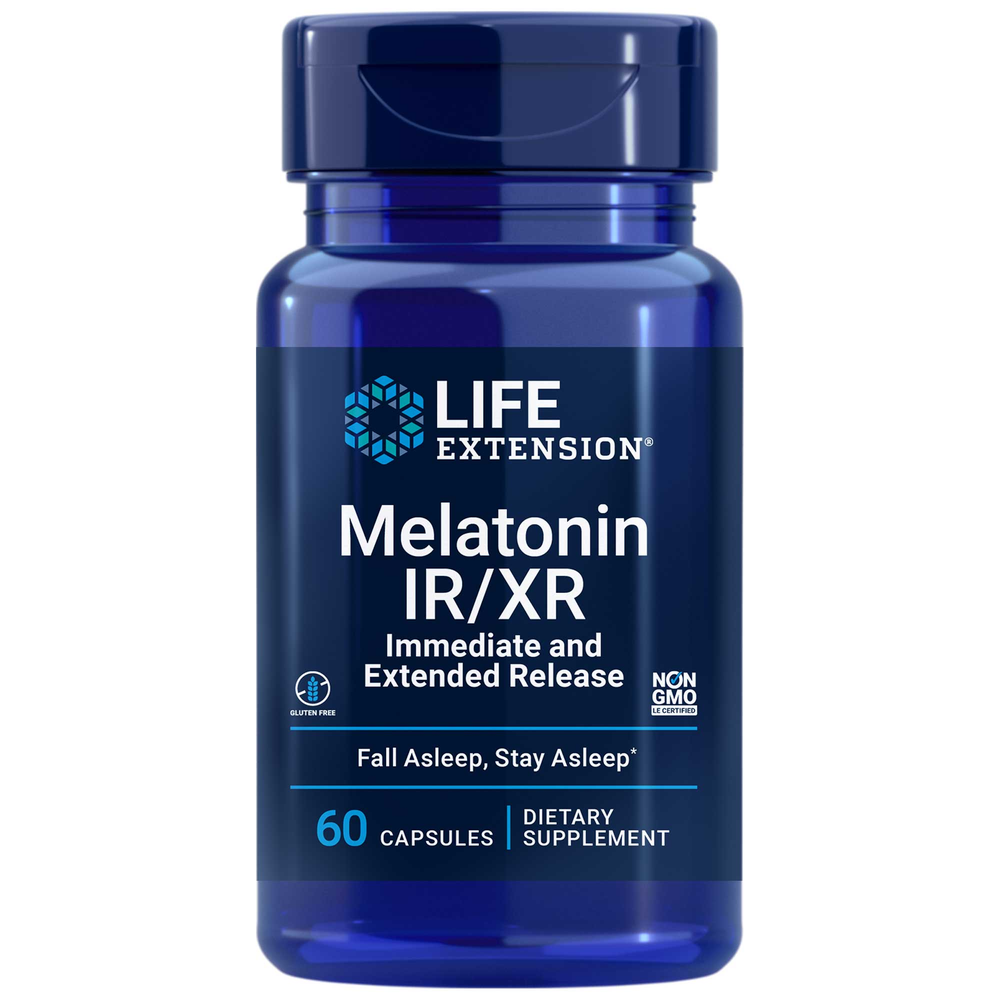
Life Extension’s Melatonin IR/XR passes each of these: a 1.5 mg total dose that sits inside the researched range rather than padding a number on the label, a named two-phase delivery approach rather than a bare “extended release” claim, manufacturing through an NSF GMP registered facility, and a single active ingredient with no sleep-blend filler.
A sensibly dosed, two-phase melatonin capsule built around real dosing and chronobiology research — the mechanism is sound and the manufacturer is verifiable, though the specific proprietary release technology hasn’t been independently trial-tested the way prescription prolonged-release melatonin has.
FAQs
Is extended-release melatonin actually better than regular melatonin?
It depends which problem you have. If you struggle to fall asleep but sleep through once you’re out, a plain immediate-release dose close to bedtime is a reasonable match. If you fall asleep fine but wake at 2 or 3 a.m., an extended- or prolonged-release formulation is designed specifically for that pattern, because it keeps measurable melatonin around for longer than a standard tablet does.
If 1.5 mg doesn’t seem to work, should I just take more?
Not necessarily. Dosing research has repeatedly found that small amounts of melatonin, well under 1 mg in some studies, can produce sleep effects comparable to much larger doses, which suggests the receptors involved saturate early rather than responding proportionally to dose. Jumping straight to 10 or 20 mg is more reliably linked to next-day grogginess than to a clearly better night’s sleep.
Can you become dependent on melatonin or build a tolerance to it?
There’s no well-established physical dependency syndrome tied to melatonin the way there is with some prescription sleep medications, but long-term nightly use at high doses hasn’t been studied as thoroughly as short-term use. Most sleep researchers suggest using the lowest dose that helps, treating it as one tool alongside consistent sleep timing and light exposure rather than the whole solution.
Who should be cautious about taking melatonin?
People taking blood thinners, immunosuppressants, or anticonvulsant medications should check with their prescriber first, since melatonin can interact with all three. It’s also worth caution during pregnancy or breastfeeding, for anyone with an autoimmune condition, and for anyone who needs to be fully alert shortly after waking, since some people experience lingering grogginess, especially with higher doses.
If your problem is falling asleep, a modest immediate-release dose close to bedtime is a reasonable place to start. If your problem is waking in the middle of the night and staying awake, that’s a different mechanism entirely, and it’s worth looking specifically for a formulation built to sustain melatonin levels through those hours rather than reaching for a bigger dose of the same fast-clearing kind.
As an Amazon Associate, The Health Verdict earns from qualifying purchases. This article is educational and is not medical advice — talk to your doctor before starting any new supplement, especially if you take blood thinners, immunosuppressant, or anticonvulsant medication, are pregnant or breastfeeding, or already take other sedating medications.