L-Theanine vs. Glycine: The Two Calming Amino Acids That Fix Completely Different Sleep Problems
A racing mind and a body that won’t cool down are two different reasons sleep doesn’t come easily — and two different amino acids, not one, are actually built to fix them.
Walk down the “sleep support” aisle and L-theanine and glycine show up in nearly every non-melatonin stack on the shelf, usually side by side, as if they’re interchangeable. They aren’t. They work on entirely different systems in the body, which is exactly why a supplement built around one of them can leave someone with the other kind of insomnia feeling like it simply didn’t work.
L-theanine is the amino acid naturally found in tea leaves. Structurally, it resembles glutamate — the brain’s main excitatory signal — closely enough to cross the blood-brain barrier and interfere with glutamate binding. Rather than sedating you, it appears to quiet excitatory signaling directly: multiple small studies have found it measurably increases alpha brain-wave activity, the same pattern seen during calm, relaxed wakefulness, while nudging up GABA, dopamine, and serotonin and turning down norepinephrine. It’s a mind-quieting molecule.
Glycine is the simplest amino acid in the body, and it already works as an inhibitory neurotransmitter in the spinal cord and brainstem. In supplemental doses, animal research and a handful of small human trials point to a second role: lowering core body temperature through peripheral vasodilation and acting on receptors in the suprachiasmatic nucleus — the brain’s master clock — nudging the body toward the thermal drop that normally accompanies falling asleep. It’s a body-temperature, sleep-architecture molecule, not primarily an anxiety one.
Who Actually Needs Which One
If your sleep problem is a mind that won’t stop narrating the day the moment the lights go off, the evidence — increased alpha waves, reduced subjective stress in small trials — points toward L-theanine’s lane. It isn’t a sedative, so it won’t force you under; it’s aimed at the racing-thought layer that keeps you from getting drowsy in the first place.
If you fall asleep without much trouble but wake up overheated, restless, or simply don’t feel rested despite seven or eight hours logged, you’re closer to the profile the small glycine trials were actually testing. Inagawa et al. (2006) measured subjective sleep quality after bedtime glycine; Bannai and Kawai’s 2012 work looked at next-day fatigue in partially sleep-restricted volunteers. Neither is about calming an anxious mind — both are about the physical mechanics of sleep once you’re already trying to get there.
How Much of Each Actually Works
L-theanine’s brain-wave studies used doses between 50 and 200 mg, and most sleep-focused guidance converges on roughly 200 mg taken 30 to 60 minutes before bed — though researchers are candid that an optimal dose specifically for sleep hasn’t been nailed down. The FDA recognizes L-theanine as generally safe up to 250 mg per serving, so 200 mg sits comfortably under that ceiling.
Glycine’s human sleep studies are more consistent on dose: nearly all of them use 3 grams, taken 30 to 60 minutes before bed — not 500 mg, not 1 gram. That detail matters more than it sounds like it should, because most glycine capsules on store shelves are sold in 500 mg to 1 g servings meant to be taken a couple of times across the day for general amino-acid support, not stacked up six capsules at once for a single bedtime dose. Safety data on glycine is reassuring at the doses that matter here: researchers have tested doses as high as 31 grams with mild nausea as the main complaint at the extremes, and the 3 g dose used in the sleep trials was reported as free of side effects.
Glycine Alone vs. Glycine + L-Theanine: What Changes
Because these two work on non-overlapping systems — one on the thermoregulatory, sleep-architecture side, the other on cognitive arousal — stacking them is mechanistically reasonable for someone whose insomnia has both a racing-mind component and a restless-body component. The strongest human evidence for pairing a calming amino acid with theanine actually exists for GABA, not glycine specifically: Kim et al. (2019) found a GABA and L-theanine combination shortened sleep latency and improved NREM sleep more than either alone in a small trial. GABA and glycine are both inhibitory signaling molecules, which makes that result suggestive for a glycine-plus-theanine pairing — but no published human trial has actually tested that exact combination, so treat it as a reasonable hypothesis built on the mechanism, not a proven stack. Several commercial sleep products, including a glycine-and-PharmaGABA bundle Thorne itself sells, are built on that same logic.
What to Look For in a Glycine Product
Most glycine products on store shelves don’t fail because the ingredient is fake — they fail on labeling and dosing details that are easy to miss unless you know to check for them.
- Free-form glycine, not a blend. Some products bury glycine inside a “recovery amino” or collagen-adjacent blend where the actual glycine content isn’t broken out. Look for a label that states grams of glycine on its own, not as part of a proprietary mix.
- A transparent per-serving dose in grams. Milligram amounts hidden inside a blended total make it impossible to know whether you’re anywhere near the 3 g studied dose. A clean label states the glycine content per capsule or scoop plainly.
- A serving size that can realistically reach 3 grams at bedtime. A product dosed and marketed purely as an all-day, spread-out amino acid supplement isn’t wrong, but it wasn’t built around the sleep protocol, and buyers who don’t do the math end up taking a fraction of the studied amount.
- Manufacture in a certified, audited facility. NSF-registered GMP, USP verification, Informed Sport, or an equivalent third-party check matters here because the actual failure mode for amino acid powders on store shelves is usually contaminant or purity testing nobody did, not a fake ingredient.
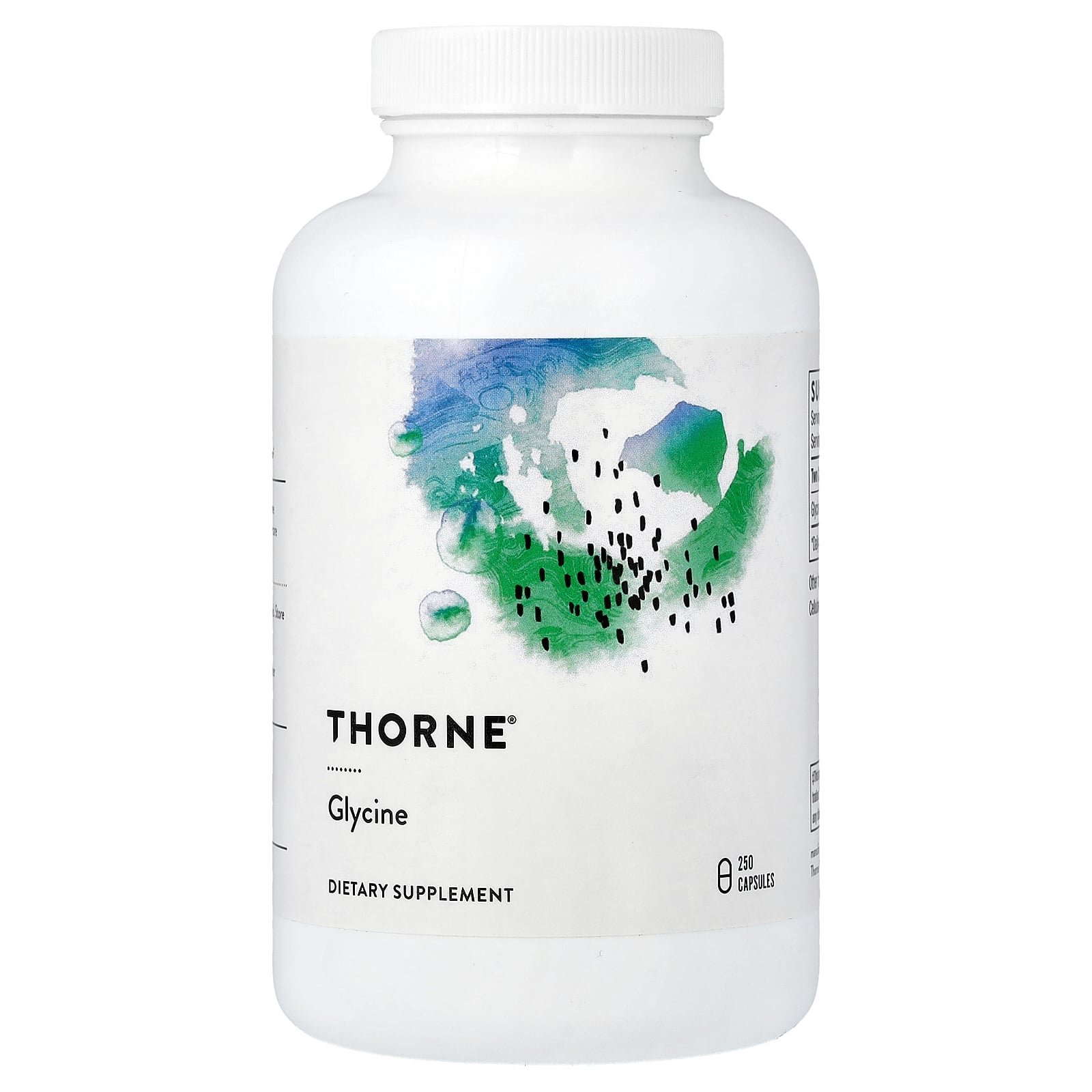
Thorne’s Glycine capsules pass the free-form and dose-transparency checks cleanly, and the brand manufactures in a certified facility. Where it falls short of a perfect score: its printed suggested use — two capsules, one to three times daily — is written for general amino-acid support, not the clinical 3 g bedtime protocol. Hitting the studied dose means taking six capsules together at night, not following the bottle as printed.
A clean, free-form, correctly-labeled glycine capsule from an established, certified maker — but the bottle’s own suggested use undersells the dose the sleep research actually used. Plan on six capsules together at bedtime, not two.
FAQs
Does glycine actually help me fall asleep faster, or just sleep better once I’m out?
Mostly the latter, and the evidence is thin either way — only three small human studies exist. The most consistent findings are improved subjective sleep quality and reduced next-day fatigue at a 3 g bedtime dose, not a measured drop in how long it takes to fall asleep. Treat it as a sleep-quality aid, not a fast-acting sedative.
Can I take L-theanine and glycine on the same night?
There’s no known interaction between the two, and the mechanistic case for combining them is reasonable since they act on different systems. But be precise about what’s actually been studied: a GABA-plus-theanine combination has published human trial data behind it, while a glycine-plus-theanine combination specifically does not. You’d be trying a logical pairing, not a proven one.
How many Thorne Glycine capsules do I actually need before bed?
Six capsules, taken together, to reach the 3 g dose used in the human sleep studies — roughly 30 to 60 minutes before bed. The bottle’s own suggested use (two capsules, one to three times a day) is written for general amino-acid support, not this specific protocol.
Is there anyone who should be careful with these?
Pregnant or breastfeeding people and anyone on sedatives, blood pressure medication, or stimulant medication should check with a doctor first, since interaction data for both compounds is limited rather than reassuring. High-dose glycine (well above the 3 g sleep dose) has been linked to mild nausea in some people; 3 g itself was reported as side-effect free in the small trials that tested it.
If lights-out means your brain won’t stop talking, start with L-theanine. If you fall asleep fine but wake up tired or overheated, start with glycine — dosed at the full 3 grams, not the smaller amount most bottles default to. If both apply, there’s a reasonable mechanistic case for using both together, though neither one substitutes for fixing an obvious underlying cause like late caffeine, a too-warm bedroom, or an undiagnosed sleep disorder.
As an Amazon Associate, The Health Verdict earns from qualifying purchases. This article is educational and is not medical advice — talk to your doctor before starting any new supplement, especially if you take sedatives, blood pressure medication, or are pregnant or breastfeeding.
n