KSM-66 vs. Sensoril Ashwagandha: Which Extract Actually Lowers Cortisol?
Ashwagandha labels throw around brand names like KSM-66 and Sensoril as if they’re interchangeable marketing badges, but they come from two different parts of the plant, two different extraction processes, and two different research records on the one thing most people are actually buying this herb for: lower cortisol.
Ashwagandha (Withania somnifera) is classified as an adaptogen, a term that gets thrown around loosely but has a specific meaning here: it’s thought to help regulate the hypothalamic-pituitary-adrenal (HPA) axis, the feedback loop that controls how much cortisol your adrenal glands release in response to stress. Chronically elevated cortisol is linked to poor sleep, abdominal fat retention, and a blunted immune response, which is why lowering it — rather than just feeling calmer in the moment — is the actual mechanism researchers are testing for.
KSM-66 and Sensoril are not just flavors of the same ingredient. KSM-66 is a root-only extract made with a proprietary water-based (aqueous) extraction process with no alcohol or chemical solvents, designed to preserve the full natural spectrum of withanolides found in the root as-is, and it’s typically standardized to 5% withanolides. Sensoril uses both leaf and root, processed with a hydroalcoholic extraction that concentrates withanolide glycosides and sitoindosides to a higher, though more variably reported, percentage — which is part of why Sensoril products are usually dosed lower per serving than KSM-66 products.
That processing difference shows up in the research base. KSM-66 has the deeper and more consistent set of randomized, placebo-controlled trials measuring serum cortisol specifically, at doses of 300–600mg per day. Sensoril’s trials more often track anxiety scores, sleep quality, and fatigue, with cortisol measured as a secondary outcome rather than the primary one. Neither extract is “better” in the abstract — they’re suited to different questions, and a label that just says “ashwagandha extract” without naming either one is telling you nothing about which research actually applies.
Who actually needs this
The clearest case for either extract is someone dealing with chronic, low-grade psychological stress — not an acute, one-off stressful week, but the kind of sustained pressure (work, caregiving, financial strain, poor sleep feeding back into more stress) that the cortisol-reduction trials were actually testing against. People who already feel wired-but-tired, or who’ve had bloodwork show elevated cortisol, are the population the KSM-66 trials were recruiting.
It is not a universal fit. Ashwagandha can stimulate thyroid hormone production, which is a problem if you have Hashimoto’s or another autoimmune thyroid condition, or if you’re already on thyroid medication without your doctor tracking the combination. It’s also generally not recommended during pregnancy, and it can have additive effects with sedatives, immunosuppressants, and some blood pressure or thyroid medications — all reasons to loop in a doctor before starting rather than treating it as a risk-free wellness purchase.

How much KSM-66 or Sensoril do you actually need
For KSM-66, the cortisol-reduction trials cluster around 300mg taken twice daily (600mg total) over 60 days, with one widely cited trial also showing benefit at a single 240mg daily dose. That 300–600mg range, standardized to roughly 5% withanolides, is the number to match against a label — a bottle offering 100mg or 150mg of KSM-66 is dosed well below what the trials used, however confident the marketing sounds.
For Sensoril, the anxiety- and stress-focused trials have used doses in the 125mg-twice-daily to 250mg-twice-daily range, reflecting its more concentrated withanolide glycoside content per milligram. Because the two extracts aren’t standardized the same way, you cannot treat “250mg of Sensoril” and “250mg of KSM-66” as equivalent doses — the research for each was built around its own extract’s concentration, not a shared one.

KSM-66 vs. Sensoril: what actually changes
Switching extracts changes the dose you should be taking, not just the brand name on the label. A product that lists “Sensoril” at 125mg twice daily and one that lists “KSM-66” at 300mg twice daily can both be correctly dosed against their own research — but a product that lists a vague “ashwagandha root extract” at some arbitrary milligram count, with no named extract and no withanolide percentage, isn’t matched to either trial, and there’s no way to know if it’s under- or over-dosed relative to anything that’s actually been studied.
What to look for in an ashwagandha product
A few concrete checks, in order of how often we see products fail them:
- The extract is named, not generic. “KSM-66 Ashwagandha” or “Sensoril Ashwagandha” on the label lets you match the dose to a specific research base; “ashwagandha root extract” alone does not.
- The withanolide percentage is disclosed. KSM-66 is typically standardized to 5% withanolides; if a label claims KSM-66 without stating that figure, or states an unusually different one, that’s worth double-checking against the brand’s own spec sheet.
- The dose sits in the range the cortisol trials actually used. 300–600mg per day for KSM-66, or 125–250mg twice daily for Sensoril — not a token 100mg “proprietary blend” amount.
- Heavy-metal testing is disclosed. Ashwagandha is a root crop grown in soil, and root vegetables are a known pathway for lead, cadmium, and arsenic accumulation; a brand that doesn’t test for and disclose this is skipping the single biggest safety concern specific to this category.
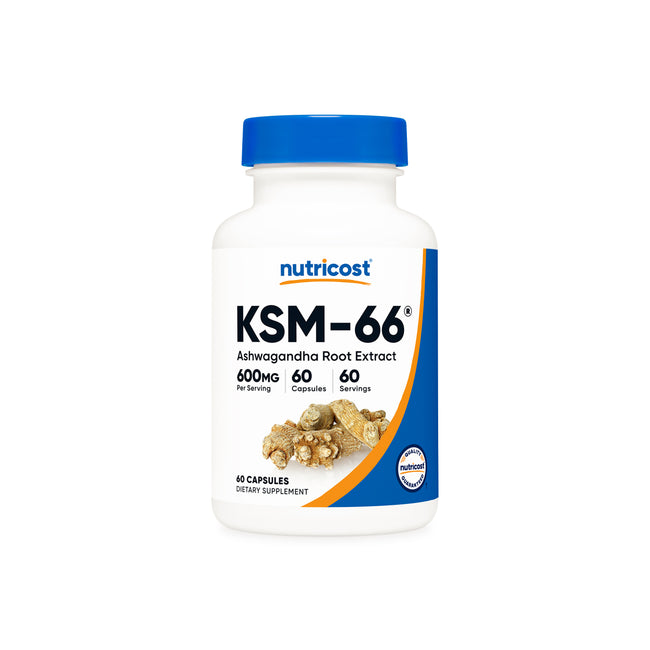
Nutricost’s KSM-66 Ashwagandha passes the first three checks cleanly: it names KSM-66 specifically, discloses the 5% withanolide standardization (30mg per 600mg serving), and dosed at 600mg it sits right at the top of the range used in the cortisol-reduction trials. Where it’s weaker is the fourth and fifth points below.
600mg of clearly named, 5%-standardized KSM-66 matches the dose used in the cortisol-reduction trials, but Nutricost’s “third-party tested” claim names no lab and offers no public Certificate of Analysis — a real gap against the heavy-metal risk specific to root crops like ashwagandha.
FAQs
Can I take ashwagandha if I have a thyroid condition?
Talk to your doctor first, specifically if you have Hashimoto’s or another autoimmune thyroid condition, or if you’re on thyroid medication. Ashwagandha has been shown to increase thyroid hormone levels in some people, which can be helpful or harmful depending on your baseline — this isn’t a supplement to self-manage around an existing thyroid diagnosis.
How long before I’d notice lower stress or cortisol?
The KSM-66 cortisol trials ran 60 days of consistent daily dosing before measuring results, and the Sensoril anxiety trials ran similarly long. This is not a same-day calming effect like an herbal tea; it’s a cumulative change worth evaluating after roughly two months of consistent use, not two weeks.
Is KSM-66 or Sensoril better for sleep specifically?
Neither extract was developed as a sleep aid first, but both have trial evidence for improving sleep quality as a downstream effect of lower stress and anxiety. If sleep onset itself is your main complaint rather than general stress, a dedicated sleep-focused ingredient is likely to help faster and more directly than either ashwagandha extract.
Do I need to cycle ashwagandha, or is it safe to take every day long-term?
The published trials ran 60 to 90 days continuously without a cycling protocol, so there’s no research-backed reason to cycle it on a fixed schedule. That said, most of the long-term safety data tops out around that same 8-to-12-week window, so if you’re taking it well beyond that, periodic check-ins with a doctor — especially on thyroid markers — are a reasonable precaution rather than a strict requirement.
If you’re dealing with sustained, chronic stress and want to try an adaptogen with real trial data behind it, matching the extract name and dose to the research above matters more than picking whichever bottle has the loudest marketing. If a brand can’t tell you which extract is inside or publish a real Certificate of Analysis, that’s a reason to keep looking before you keep taking it daily for months.
As an Amazon Associate, The Health Verdict earns from qualifying purchases. This article is educational and is not medical advice — talk to your doctor before starting any new supplement, especially if you have a thyroid condition, are pregnant, or take sedatives, thyroid medication, or immunosuppressants.