Glucosamine Sulfate vs. Glucosamine Hydrochloride: Why Joint Health’s Best Evidence Belongs to Only One Form
The biggest glucosamine trial ever run — 1,583 patients, funded by the NIH — found no significant benefit over a sugar pill across the full study group. The salt form it tested wasn’t the one most of the earlier, more encouraging research had used.
Cartilage is living tissue, not inert padding. Inside it, chondrocyte cells continuously build and rebuild a mesh of collagen and proteoglycans — long sugar-chain molecules called glycosaminoglycans that hold water and give cartilage its cushioning, shock-absorbing structure. Glucosamine is one of the basic raw materials those cells use to assemble that mesh. As cartilage wears down with age, repetitive joint loading, old injury, or excess weight, the theory behind supplementing is simple: give the body more of the raw material it uses to rebuild, and rebuilding might keep slightly ahead of breakdown.
Here’s the complication that most “does glucosamine work” arguments skip past: glucosamine on a supplement label is never just glucosamine. It’s sold almost everywhere as one of two different salts — glucosamine sulfate, bound to a sulfate ion, or glucosamine hydrochloride (HCl), bound to a chloride ion. Once absorbed, both are supposed to deliver the same core amino sugar. But the two forms have almost entirely separate research histories, and that split is not a minor technicality — it’s the difference between citing a trial that actually tested what’s in your bottle and citing one that tested something else wearing the same name.
The timeline matters here. Starting in the late 1990s, a run of European trials — Reginster’s 2001 study and Pavelka’s 2002 follow-up chief among them — tested a specific crystalline glucosamine sulfate formulation over three years and found it slowed the rate of joint-space narrowing on X-ray, a structure-modifying claim well beyond ordinary pain relief. Then in 2006 the NIH funded GAIT (the Glucosamine/chondroitin Arthritis Intervention Trial), the largest and most rigorous U.S. study of its kind at 1,583 patients — and GAIT tested glucosamine hydrochloride, not sulfate. Across the full study population, neither glucosamine HCl, chondroitin, nor the combination beat placebo by a statistically significant margin. Only a smaller subgroup with moderate-to-severe baseline pain showed a meaningful signal, and the researchers flagged that subgroup finding as needing confirmation. A 2014 meta-analysis complicated the sulfate side too, finding its structure-modifying effect was concentrated in trials of one particular manufacturer’s formulation and became clinically unimportant once that concentration was accounted for — so this isn’t a clean story where sulfate wins and HCl loses. It’s a story where the specific thing you’re taking, and the specific trial you’re citing for it, have to actually match.
Who Actually Needs This
The population the better trials were actually run on is narrow: adults with a doctor-confirmed diagnosis of mild-to-moderate knee osteoarthritis, especially those who don’t tolerate long-term NSAID use well and are looking for an adjunct, not a replacement, for standard care. It is not aimed at acute injuries, meniscus or ligament damage, or severe end-stage OA where imaging already shows bone-on-bone contact — those situations call for an orthopedic evaluation, not a bottle off a supplement shelf.
It’s also a reasonable thing to try for someone managing long-term joint wear from running, lifting, physical work, or an old injury, who wants to add something low-risk alongside physical therapy and weight management rather than instead of it — as long as the expectations are realistic. This is not a fast-acting painkiller. By the trial designs themselves, whatever benefit shows up is measured in months, not days.

How Much — and How Long Before It Works
The dose used across both GAIT and the earlier European sulfate trials was essentially identical: 1,500 mg per day of glucosamine, plus 1,200 mg per day of chondroitin sulfate, typically split into two servings rather than taken all at once. That consistency across otherwise very different trials is useful to know, because a lot of product on shelves doses well under that — especially once glucosamine becomes one ingredient in a multi-compound “joint complex” that spreads a modest total milligram count across five or six other things, none of which get anywhere near the dose that was actually studied.
On timing: the GAIT subgroup signal and the European joint-space findings were both measured starting at 24 weeks at the earliest, with the structure-modifying (joint-space-narrowing) results tracked over one to three years of continuous use. If the plan is to take glucosamine for two weeks and judge it by whether a knee feels different, that’s a timeline no trial supporting this category ever used — for better or worse.

Glucosamine Sulfate vs. Glucosamine Hydrochloride: What Changes
Chemically, the two forms deliver the same glucosamine molecule attached to a different counter-ion — sulfate or chloride — and some researchers propose that the sulfate form is more bioavailable and clears the body more slowly, though that mechanism is still described as “thought to be” rather than conclusively settled. What’s better established is the trial record itself: studies specifically using glucosamine HCl, GAIT among them, have mostly reported nonsignificant results for the general study population, while the sulfate form carries the (imperfect, brand-concentrated) structure-modifying evidence described above. There’s also a plain economic reason HCl shows up so often in mass-market products: it’s cheaper to manufacture at a given dose, which is part of why it turns up in high-count “extra strength” blends and multi-ingredient formulas that lean on a big total milligram number rather than the specific salt form the research was actually built around.
What to Look For in a Glucosamine Product
Most glucosamine products fail on one of four points before you even get to whether the research itself holds up:
- The label specifies “sulfate,” not just “glucosamine.” A bottle that lists only “glucosamine” with no salt form named is very often HCl by default, since it’s the cheaper input — and that choice should be disclosed, not buried.
- The dose matches the 1,500 mg / 1,200 mg regimen. Products that advertise a big combined milligram count but split it across six joint-support ingredients rarely deliver a trial-matching dose of either glucosamine or chondroitin specifically.
- The chondroitin source and form are disclosed. “Chondroitin complex” with no named source or standardization is a common place for cost-cutting to hide, since chondroitin itself is one of the more expensive raw materials in this category.
- Manufacturing is independently verifiable. A GMP claim you can actually trace to a registered facility is worth more than a quality seal printed on the bottle with no way to check it.
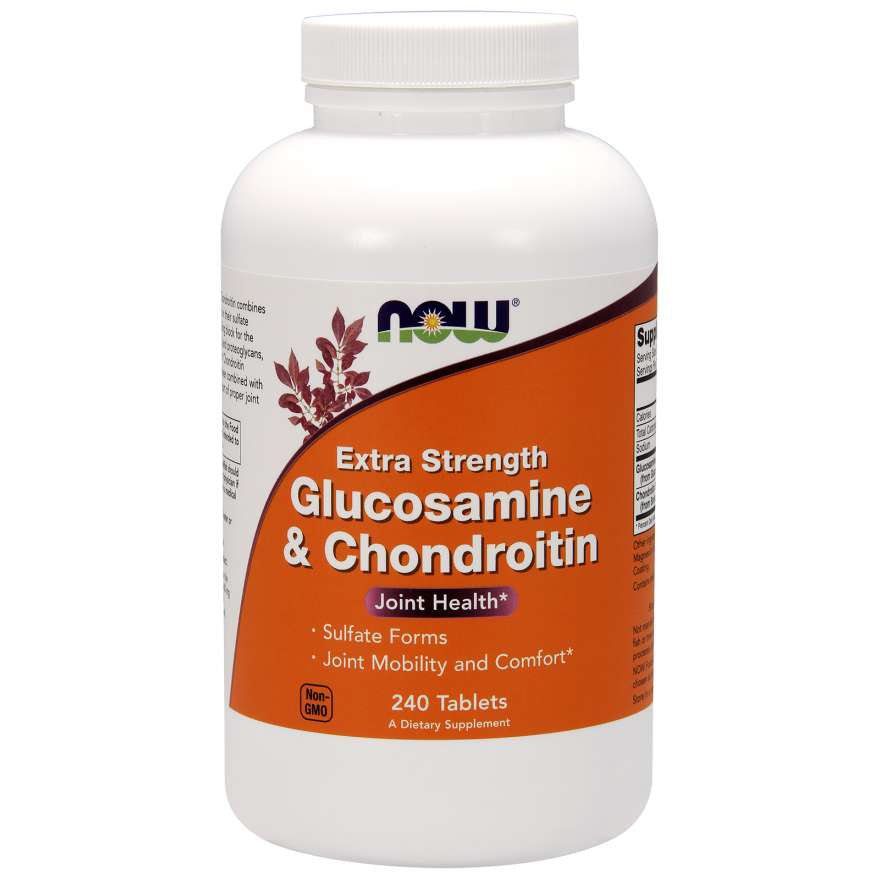
NOW Foods’ Glucosamine & Chondroitin Extra Strength names “Sulfate Forms” directly on the label for both ingredients, doses at exactly 1,500 mg glucosamine sulfate and 1,200 mg chondroitin sodium sulfate (from bovine cartilage, explicitly disclosed) per two-tablet serving, and comes from a manufacturer with a long-published, independently documented GMP program — passing on transparency and dose-matching even where the category’s underlying research stays genuinely mixed.
A transparently labeled, trial-matching-dose sulfate formulation from a verifiable manufacturer — the product itself does everything right, but the underlying research for this category as a whole is genuinely mixed, including for the better-studied salt form.
FAQs
Does glucosamine actually work for joint pain?
The honest answer is: it’s mixed, and the form matters to the answer. The largest U.S. trial (GAIT, using glucosamine hydrochloride) found no statistically significant benefit over placebo across the full study group, with only a smaller subgroup showing a signal. Earlier European trials using a specific crystalline glucosamine sulfate formulation found it slowed joint-space narrowing over several years, though a later meta-analysis found that effect was concentrated in one manufacturer’s product. Treat it as a modest, unproven-but-plausible option rather than a guaranteed fix.
How long before I’d notice a difference?
The trials that found any benefit measured it starting at 24 weeks, with the structure-modifying (joint-space) findings tracked over one to three years. If you don’t notice anything in the first month, that’s consistent with how this was studied, not necessarily a sign it isn’t working.
Is it safe to take with blood thinners like warfarin, or if I have a shellfish allergy?
Both are worth flagging to your doctor specifically. Regulatory agencies, including Singapore’s HSA, have published case reports of elevated INR (a measure of blood-clotting time) in patients taking glucosamine alongside warfarin, so that combination needs medical supervision rather than independent judgment. Separately, glucosamine is frequently derived from shellfish shells unless a product is explicitly labeled vegetarian or shellfish-free, which matters if you have a shellfish allergy.
Should I take glucosamine with chondroitin, or by itself?
Most of the trial evidence, including GAIT’s subgroup signal, tested the combination rather than glucosamine alone, so a combined product like this one matches the research more closely than a glucosamine-only supplement would.
If you have doctor-confirmed mild-to-moderate knee osteoarthritis, aren’t on blood thinners without medical supervision, and are willing to commit to a trial-matching dose for at least a few months before judging it, a transparently labeled glucosamine sulfate product like this one is a reasonable, low-risk thing to try. If you’re looking for fast pain relief or have severe, imaging-confirmed joint damage, this isn’t the right tool — talk to an orthopedist instead.
As an Amazon Associate, The Health Verdict earns from qualifying purchases. This article is educational and is not medical advice — talk to your doctor before starting any new supplement, especially if you take warfarin or another blood thinner, or have a shellfish allergy.