EPA vs. DHA: Why the Split on Your Fish Oil Label Matters More Than the Total
The big number on the front of the bottle is fish oil. The two numbers on the back are the ones doing the work — and almost nobody compares them.
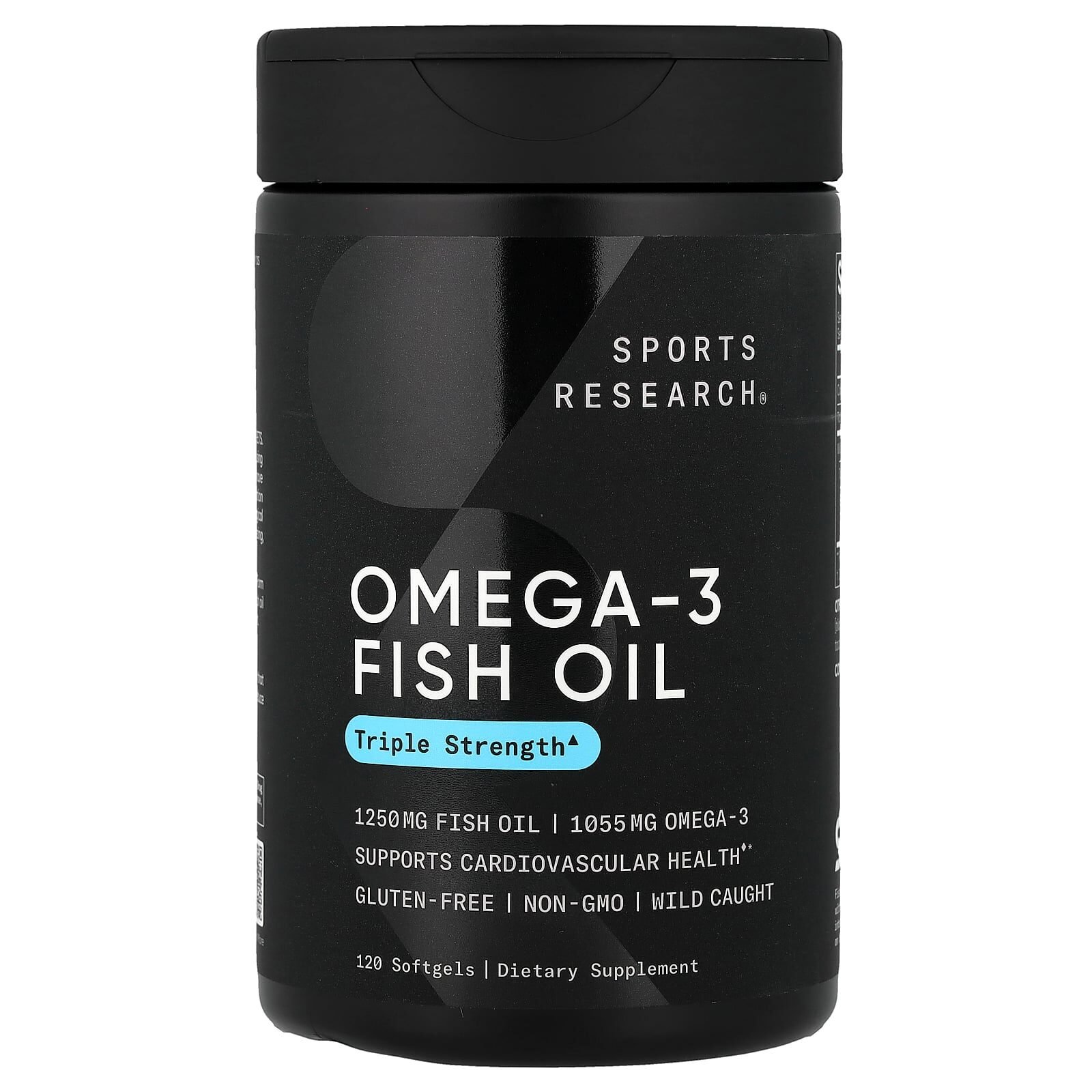
Pick up almost any fish oil and the front of the label shouts one figure. On the bottle in front of me it is 1,250 mg. That number is the weight of the oil in the softgel, not the weight of the thing you are buying it for. Turn it over and the real accounting appears: 1,055 mg of total omega-3s, and inside that, 690 mg of EPA and 310 mg of DHA. Roughly 69 percent EPA, 31 percent DHA.
That ratio is not a rounding detail. EPA and DHA are both long-chain omega-3 fatty acids, they both come out of the same oily fish, and they are almost always printed on the same line of a label — but they are not doing the same job in your body. EPA is mostly a signalling molecule. It is the raw material your cells convert into resolvins and into a less inflammatory class of prostaglandins, competing for the same enzymes that arachidonic acid uses to drive inflammation up. DHA is mostly structural. It gets built into cell membranes and then stays there, and it accumulates most heavily in the places that need membranes to stay fluid and fast: the gray matter of the brain and the photoreceptor membranes of the retina.
And your body will not freely convert one into the other to fix a lopsided bottle. DHA back-converts to EPA to a modest degree, so a DHA-heavy product does supply some EPA indirectly. The reverse barely happens — adults convert EPA to DHA poorly. Which means the ratio you swallow is, give or take, the ratio you get. Buying by the 1,250 figure and ignoring the split is how people end up taking the wrong omega-3 for the reason they started taking it.
What each one actually does
The clearest signal for EPA specifically comes out of the mood literature, because that is where enough trials have accumulated to separate the two. A 2019 meta-analysis in Translational Psychiatry pooled 26 double-blind, randomised, placebo-controlled studies covering 2,160 participants and found a small but statistically significant overall benefit of omega-3 supplementation for depressive symptoms (standardised mean difference −0.28, P = 0.004). The interesting part is what happened when the authors sorted trials by formulation. Pure-EPA preparations beat placebo (SMD −0.50, P = 0.003). So did EPA-majority preparations, defined as at least 60 percent EPA of total EPA plus DHA (SMD −1.03, P = 0.03). Pure-DHA and DHA-majority preparations did not show the same benefit.
DHA’s case is structural rather than symptomatic, and it is not really in dispute: it is the dominant omega-3 in neural and retinal membranes, which is why it is the form emphasised during pregnancy and infant development, and why DHA rather than EPA is what prenatal formulas are built around. Two honest caveats belong here. The depression trials each compared a formulation against placebo, not EPA head-to-head against DHA, so the cleanest reading is "EPA-dominant products have evidence behind them and DHA-dominant ones have not shown the same effect," not "DHA does nothing." And effect sizes in that literature are modest — this is adjunctive support, not a replacement for treatment.

How much, and in what ratio
Dose is where label-reading stops being academic. In the depression meta-analysis above, the formulations that worked were tested at EPA doses at or below 1 g per day — so one softgel of a 690 mg-EPA product sits inside the studied range, and two comfortably exceed it. The picture is different for blood lipids and cardiovascular endpoints, where the trials that moved hard outcomes used several grams of omega-3 per day, usually as prescription preparations rather than retail softgels. A single capsule delivering 1,055 mg of total omega-3 is a reasonable nutritional top-up. It is not a trial dose, and it is worth being clear-eyed about that before assuming one capsule reproduces a headline from a clinical trial.
There is also a genuinely unsettled question sitting underneath all of this. The large prescription trial that did reduce cardiovascular events used a purified EPA preparation with no DHA in it at all; a comparably sized trial of a combined EPA-plus-DHA preparation did not reproduce the benefit, and researchers are still arguing about why — including about whether the placebo oils used in the two trials were really equivalent. Treat anyone who tells you that argument is settled with suspicion. What it does justify is paying attention to the split rather than assuming any two fish oils at the same milligram count are interchangeable. On the practical side, take it with a meal that contains some fat: these are fat-soluble, and absorption is meaningfully better with food than on an empty stomach.

EPA-dominant vs. balanced: what changes
At 690 mg EPA to 310 mg DHA, this is squarely an EPA-dominant product, and that suits some goals better than others. If you are taking omega-3s with inflammation or mood in mind, the EPA-weighted evidence is the stronger of the two and a roughly 2:1 EPA-to-DHA product lines up with it. If your reason is pregnancy, infant development, or the structural side — neural and retinal membranes, where DHA is the fatty acid actually being installed — then a 69-percent-EPA bottle is the wrong tool, and a DHA-dominant or prenatal-specific formula is what you want. A balanced roughly 1:1 product is the reasonable hedge if you have no particular target and simply want to raise a low intake. None of these is a better product in the abstract; they are different products that happen to share a shelf and a front-label number.
What to look for in an omega-3 supplement
Four checks, ordered by how often products fail them rather than by how often they get talked about.
- The EPA and DHA figures, not the fish-oil figure. This is the one almost everything fails, because the incentive runs the other way: the oil weight is always the bigger, more flattering number. If a label gives you "1,000 mg fish oil" and no breakdown, you have no idea what you are buying. A product that prints EPA and DHA separately has told you the only two things that matter.
- The chemical form. Omega-3s come as natural triglycerides, re-esterified triglycerides, or ethyl esters, and the ethyl ester form is both the cheapest to make and the least well absorbed. Labels that specify "triglyceride form" or "rTG" are volunteering information that cheaper products quietly omit.
- Published, lot-level oxidation testing. Fish oil goes rancid, and rancid oil is the failure mode nobody checks for because you cannot taste it through a softgel shell. The numbers to want are peroxide value, anisidine value and their combination, TOTOX. A brand that posts per-lot third-party reports is letting you verify this; a brand that says only "third-party tested" is asking you to take its word.
- A named source and a straight story about it. Species, catch region, and a sustainability certification you can look up. This is the softest of the four checks, but inconsistency here tends to indicate how carefully the rest of the label was written.
The Sports Research product clears the first three cleanly. The split is printed plainly, the oil is declared in re-esterified triglyceride form, and the brand participates in IFOS, whose lot reports are public — the ones I could pull showed a five-star rating with measured EPA and DHA slightly above label claim and oxidation numbers far inside the limits, with TOTOX around 4 to 6 against a ceiling of 19.5 and mercury, lead, arsenic and cadmium at or below detection. It is the fourth check where it wobbles, which is where the deductions below come from.
A plainly disclosed 690 mg EPA / 310 mg DHA split in re-esterified triglyceride form, backed by public IFOS lot reports with excellent oxidation and heavy-metal results — held back by a label that names two different fish sources and by the absence of a published report for the lot currently shipping.
FAQs
Should I be taking EPA or DHA?
It depends on why you started. For inflammation and mood, the evidence sits with EPA-dominant formulations — the pooled trials that beat placebo were pure-EPA or at least 60 percent EPA. For pregnancy, infant development, and the structural side of brain and eye health, DHA is the one being physically built into membranes, and a DHA-dominant or prenatal formula is the better fit. If you have no specific target and just want to raise a low intake, a roughly balanced product is a sensible default.
Does "1,250 mg fish oil" mean I’m getting 1,250 mg of omega-3s?
No, and this is the single most common misreading on the shelf. That figure is the weight of the oil in the softgel. The omega-3 content is a subset of it — on this product, 1,055 mg of the 1,250 mg, which is unusually high. Plenty of cheaper fish oils advertise 1,000 mg of oil and deliver only around 300 mg of combined EPA and DHA. Always read the two broken-out numbers instead.
Does the triglyceride form really absorb better than ethyl ester?
Better, yes; dramatically better, no. Ethyl ester omega-3s need an extra enzymatic step before absorption, and comparison studies generally show somewhat lower uptake than triglyceride forms, particularly when taken without food. The practical gap narrows considerably if you take an ethyl ester product with a proper fatty meal. It is a reason to prefer triglyceride form at a similar price, not a reason to throw out a bottle you already own.
Can I skip the supplement and just eat fish?
Yes — that is the better option if you will actually do it. Two servings a week of oily fish such as salmon, sardines or mackerel is the usual dietary benchmark, and whole fish brings protein, selenium and iodine that a softgel does not. Supplements exist for the realistic case: people who do not like oily fish, cannot afford it weekly, or are avoiding it during pregnancy over mercury concerns and need a tested, low-contaminant DHA source instead.
If you are already taking a fish oil, the useful thing to do today is not to buy a new one — it is to turn the bottle you own around and find the EPA and DHA lines. If they are not printed separately, that is your answer. If they are, check whether the split matches the reason you bought it: EPA-weighted for inflammation and mood, DHA-weighted for pregnancy and the structural brain-and-eye case. This Sports Research bottle is a straightforward pick for the first of those, with an honest label, a well-absorbed form, and public third-party lot data that very few competitors bother to publish. Two things keep it off a higher score: the listing describes the oil as coming from wild Alaska pollock while the allergen statement names anchovy, sardine and mackerel, and the IFOS reports available to read cover older lots rather than the one currently on shelves. Neither is disqualifying. Both are the kind of thing a brand this close to doing everything right should simply tidy up.
As an Amazon Associate, The Health Verdict earns from qualifying purchases. This article is educational and is not medical advice — talk to your doctor before starting any new supplement, especially if you take a blood thinner such as warfarin or a direct oral anticoagulant, as high-dose omega-3s can affect bleeding risk, or if you are pregnant and choosing between EPA- and DHA-weighted products.