Creatine Loading Buys You About Three Weeks — Here’s What It Costs
Creatine is one of the most heavily studied supplements that exists, and the question we get asked more than almost any other has nothing to do with whether it works — it’s whether the loading phase everyone recommends is actually necessary, or just a habit left over from the 1990s.
Creatine works by topping off a small, finite reservoir in your muscle tissue: phosphocreatine, which your muscles use to instantly regenerate ATP during short, hard efforts like a heavy set or a sprint. Supplementing raises that reservoir until it hits a ceiling — your muscles can only hold so much creatine no matter how much you take — and once you’re saturated, the performance benefits (more reps, slightly faster sprint times, better high-intensity output) show up and plateau.
The “loading phase” — a short run of much higher daily doses before dropping to a small daily maintenance amount — became standard practice after a 1992 study by Roger Harris and colleagues showed it filled that reservoir faster than a low dose taken from day one. That finding is still accurate. What it doesn’t establish is whether getting there faster is worth what a bigger dose does to your stomach along the way.
Most people now load by default, without ever being told there’s a second, slower option that gets them to the exact same saturated endpoint — just a few weeks later and, per the research below, with meaningfully less bloating and GI distress in the meantime.
Who actually needs to load
Loading makes the most sense for anyone working against a real calendar — a competition, a shoot, a training camp — where being saturated in five to seven days instead of four weeks has genuine value. If there’s no deadline, that speed advantage doesn’t do much for you, and you’re left holding only the downside: a bigger daily dose for a week or two.
Your starting point also matters. People who already eat a lot of red meat and fish walk in with higher baseline muscle creatine stores (dietary creatine comes almost entirely from animal flesh), so they have a smaller gap to fill either way. Vegetarians and vegans typically start lower and see a larger relative increase from supplementing — but that’s true whether they load or not; it doesn’t change which approach gets them there with less discomfort.

How much creatine the research actually supports
The International Society of Sports Nutrition’s position stand lays out both protocols in body-weight terms: a loading dose of about 0.3 grams per kilogram per day, split into four or five smaller servings, for five to seven days, followed by a maintenance dose of about 0.03 grams per kilogram per day — roughly 3 to 5 grams daily for most adults — continued indefinitely. In flat numbers, that’s commonly described as 20 to 25 grams a day while loading, then 3 to 5 grams a day after.
The no-loading alternative is simpler: skip straight to the 3-to-5-gram daily maintenance dose from day one. A frequently cited 1996 study by Hultman and colleagues found that approach reaches the same fully saturated muscle creatine level as loading does — it just takes about 28 days to get there instead of 5 to 7. The ceiling is identical either way; only the runway length changes.

Loading vs. no loading: what changes
A 2025 randomized trial (24 completers, 28 days) put this head-to-head: one group took a straight 5 grams a day with no loading, the other took a 14-day loading dose of 20 grams a day before dropping to maintenance. Overall, 79.2% of participants reported at least one GI symptom over the study, so creatine’s reputation for occasional stomach trouble is real regardless of protocol — but the loading group reported bloating in two out of three people (66.67%) versus about 42% in the no-load group, and reported significantly more stomach discomfort than the no-load group, the one difference in the study that reached statistical significance despite the small sample. Water retention came out roughly equal between the two groups (50% each). Worth noting: this trial’s loading arm ran 14 days, longer than the standard 5-to-7-day protocol, so a shorter real-world load may land somewhere between these two groups — but the direction of the trend matches what’s been reported anecdotally for decades.
What to look for in a creatine product
A few concrete checks, ordered by how often we see products fail them:
- Third-party certification is actually present. NSF Certified for Sport, Informed Sport, or a comparable mark. Plain creatine monohydrate is cheap to produce, which means a lot of tubs skip testing entirely rather than pay for it.
- It’s single-ingredient creatine monohydrate. No “muscle recovery blend” or proprietary mix diluting the actual creatine dose with filler compounds you can’t independently verify the amount of.
- The dose per serving is disclosed in plain grams. Should state 5 grams (or close to it) clearly on the label — not buried inside a combined-ingredient total.
- Manufacturing happens in an audited, certified facility with a Certificate of Analysis you can actually request. This is the check that catches heavy-metal contamination and dosing drift before a batch ships, and it’s the one most private-label tubs can’t produce on request.
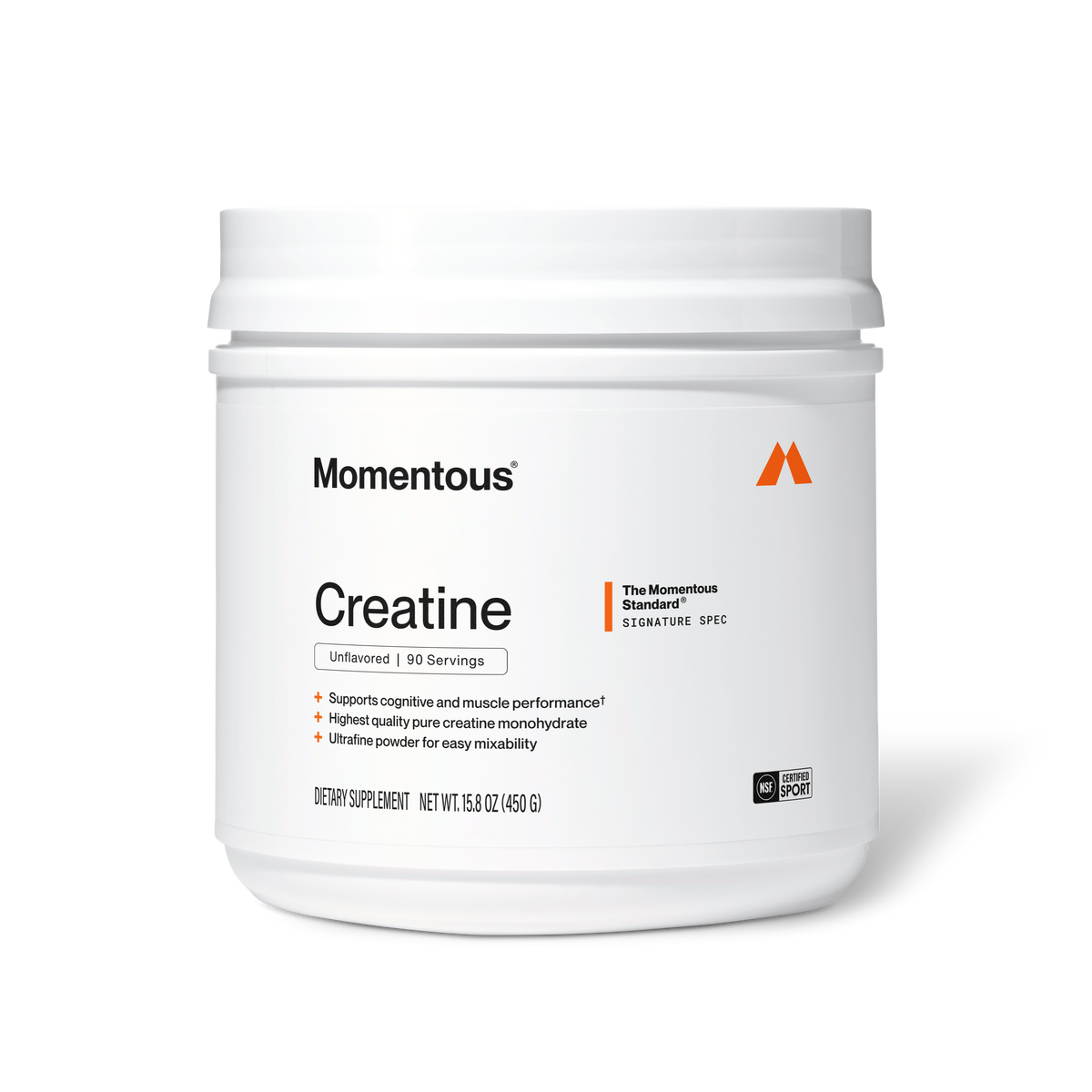
Momentous’s creatine monohydrate passes all four: it’s NSF Certified for Sport, a single-ingredient monohydrate powder at a disclosed 5-gram serving, run through a six-stage third-party testing protocol that screens for heavy metals, microplastics, and PFAS, and manufactured in an ISO 9001- and ISO 14001-certified facility.
A plain, single-ingredient creatine monohydrate at a disclosed 5-gram dose, backed by real third-party testing and facility certification — the loading-phase question here is about your patience, not about whether this product works.
FAQs
If I skip the loading phase, am I losing out on long-term results?
No evidence supports that. Both protocols are shown to reach the same fully saturated muscle creatine level — loading just gets you there in about a week instead of about four. Skipping it costs you time, not your eventual ceiling.
Does loading actually cause more bloating and stomach issues?
A 2025 trial found loaders reported bloating about 1.5 times more often than non-loaders and reported significantly more stomach discomfort — the one difference that held up statistically in that study. Water retention was about the same either way, so the GI effects, not the water weight, are where loading seems to cost the most.
Can I load with smaller, more frequent doses to reduce side effects?
Many people already split the standard 20-to-25-gram loading dose into four or five smaller 5-gram servings across the day specifically to ease GI load, and that’s consistent with how the research protocols are actually structured. It hasn’t been tested head-to-head against skipping loading entirely, so treat it as a reasonable way to make loading more tolerable, not a proven substitute for it.
Does taking creatine before or after a workout matter more than loading does?
Less than loading does. Most research finds little to no meaningful difference in strength or muscle outcomes based on when you take creatine relative to training — consistency, taking it daily regardless of time, matters far more than the clock.
If you have a competition, a shoot, or any other hard deadline inside the next month, loading is a legitimate way to buy yourself time. If you don’t, a plain 3-to-5-gram daily dose gets you to the identical saturated endpoint in about four weeks, with meaningfully less chance of spending that month bloated.
As an Amazon Associate, The Health Verdict earns from qualifying purchases. This article is educational and is not medical advice — talk to your doctor before starting any new supplement, especially if you have kidney disease or any kidney function concerns, since creatine increases the kidneys’ filtration workload.