Why Collagen Alone Doesn’t Rebuild Anything (And What Actually Makes It Work)
Collagen powder is one of the best-selling supplement categories in the country right now, and most tubs on the shelf are missing the one nutrient your body actually needs to turn what you’re swallowing into new tissue.
Collagen is the most abundant protein in your body — the structural scaffolding in skin, tendons, cartilage, and bone. Types I and III are the ones that show up in nearly every supplement tub, because they’re the forms most relevant to skin and joint tissue. Your own production of it starts declining in your mid-20s, roughly a percent or so a year, and that decline speeds up noticeably after menopause. Supplementing with “collagen” doesn’t mean it arrives in your body still labeled collagen, though — your gut breaks it down into amino acids and small peptides just like it would any other protein you eat.
What happens next is where the real differences between products show up. Hydrolyzed collagen — collagen that’s been pre-broken into shorter peptide chains before it ever reaches you — absorbs more efficiently than intact collagen or plain gelatin, and a subset of those short peptides appear to survive digestion intact enough to directly signal fibroblasts and chondrocytes (the cells that build skin and cartilage) to ramp up their own collagen production. That’s the basis for specific, patented “bioactive collagen peptides” like FORTIGEL, which get tested in their own clinical trials rather than lumped in with generic collagen research.
But none of that matters much if your body can’t finish the job. Assembling amino acids into a stable, cross-linked collagen fiber requires two enzymes — prolyl hydroxylase and lysyl hydroxylase — and both of them need vitamin C as a cofactor to function. This is not a minor footnote; it’s the actual mechanism behind scurvy, where a body starved of vitamin C could still eat plenty of protein but couldn’t hold its gums, skin, or blood vessels together. Most collagen tubs never mention this. The ones worth buying build around it.
Who actually needs a collagen supplement
The clearest candidates are anyone past their mid-20s whose natural production has already started tapering off, postmenopausal women dealing with the steeper drop that comes with lower estrogen, endurance and strength athletes putting repeated load through tendons and cartilage, anyone rehabbing a tendon or ligament injury, and people specifically bothered by skin elasticity or hydration who’ve already got the basics — sleep, sun protection, hydration — handled.
It’s a weaker case if you’re already eating adequate total protein and a vitamin-C-rich diet with no joint or skin complaints — you may not notice much. And collagen shouldn’t be your main protein source around workouts either way: it’s an incomplete protein, low in tryptophan, so it’s a targeted addition to your diet rather than a replacement for whey, eggs, or other complete proteins.

How much collagen — and which form — actually matters
Dosing depends heavily on what outcome you’re after. Studies looking at skin hydration and elasticity generally use 2.5–10 grams of hydrolyzed collagen a day over 8–12 weeks. Studies on joint comfort in athletes and early-stage osteoarthritis tend to run higher, often 5–15 grams daily sustained over several months. The specific patented peptide FORTIGEL has its own clinical research built around a 5-gram daily dose targeting joint cartilage and comfort — a far more precise number than a label that just says “10,000mg collagen blend” without disclosing which peptide you’re actually getting or whether it matches anything that’s been studied.
Source matters too, though less than dose and disclosure do. Bovine (grass-fed cattle) collagen supplies mostly Type I and III, has the deepest research base overall, and tends to be the more affordable option. Marine (fish skin and scale) collagen is also Type I, often has a smaller peptide size that some research suggests absorbs a bit faster, and shows up more in skin-focused products — but its joint-specific evidence base is thinner. Neither source is categorically better; the more useful question is whether the label names a real, dosed peptide instead of hiding behind a vague blend.

Collagen alone vs. collagen + vitamin C: what changes
Taking straight hydrolyzed collagen does supply the right raw materials — glycine, proline, and hydroxyproline in unusually high concentrations compared to other proteins. That part of the label claim holds up regardless of what else is in the tub. What it doesn’t guarantee is that your body can finish converting those amino acids into new, structurally sound collagen fibers, because that final assembly step runs through vitamin-C-dependent enzymes. Without enough vitamin C on board, you’re still getting protein — you’re just not necessarily getting the collagen-synthesis benefit the marketing implies. A product built around both pieces is targeting the full pathway instead of just the first half of it.
What to look for in a collagen product
A few concrete checks, in order of how often we see products fail them:
- The peptide is hydrolyzed, and ideally, named. “Collagen” or “collagen peptides” alone tells you almost nothing about molecular weight or whether it matches a studied dose — a disclosed, branded peptide at a stated gram amount is the difference between a claim and a citation.
- Vitamin C is included or clearly paired. This is the single most commonly skipped ingredient in the category, and without it your body has the raw material but not the finished enzymatic pathway to use it fully.
- The dose sits in a research-backed range for your actual goal, not a token amount padded out with flavoring and sweeteners. Skin and joint outcomes were studied at different doses — check which one the label is actually built around.
- The brand publishes third-party testing — NSF Certified for Sport or Informed Sport, specifically, given that cheaper bovine and marine collagen supply chains have a documented history of heavy-metal contamination.
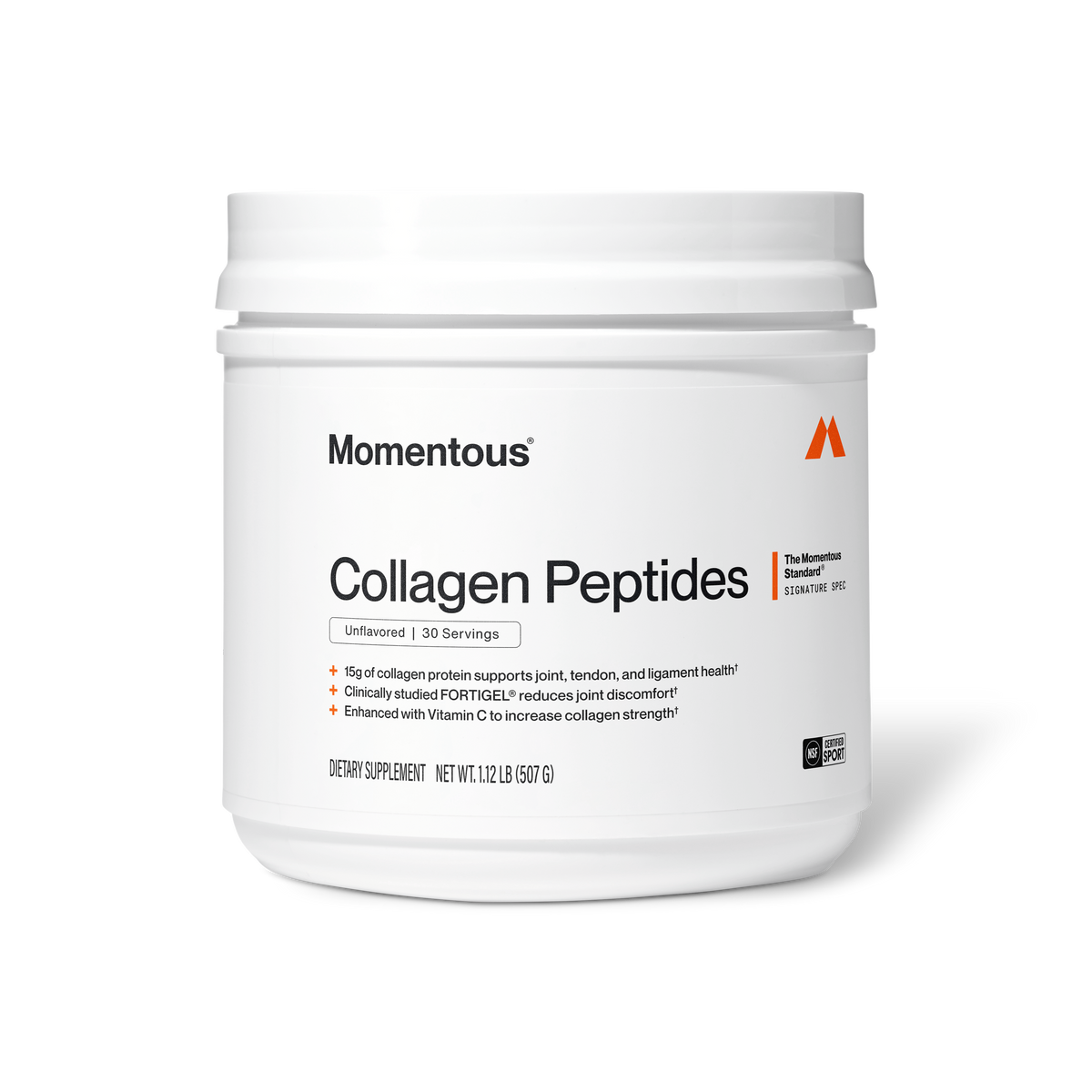
This is exactly the combination we found in Momentous Grass-Fed Collagen Peptides — a named, clinically studied peptide at its full researched dose, paired with vitamin C, and NSF Certified for Sport so you know what’s actually in the tub.
Pairs a full 5-gram researched dose of FORTIGEL collagen hydrolysate with grass-fed collagen peptides and vitamin C in a single scoop, third-party tested and NSF Certified for Sport.
FAQs
Does the collagen I drink actually turn into collagen in my body, or does it just get digested like any other protein?
Both, in a sense. Like any protein, it’s broken down into amino acids and small peptides during digestion — that part is ordinary. But research on hydrolyzed bioactive collagen peptides suggests some specific fragments survive digestion intact enough to signal fibroblasts and chondrocytes to ramp up their own collagen production, which is a different mechanism than just supplying raw amino acids the way a scoop of whey would. That signaling effect is what the clinical research on named peptides is actually testing.
Does it matter if the collagen is bovine (cow) or marine (fish)?
Somewhat. Bovine collagen supplies mostly Type I and III, has the deepest research base overall — especially for joints — and is usually the cheaper source. Marine collagen is also Type I, tends to have a smaller peptide size some research links to slightly faster absorption, and is popular in skin-focused products, but has a thinner evidence base for joint outcomes specifically. Pick based on the outcome you’re targeting, and any shellfish or beef allergy you’re managing.
How long before I’d actually notice a difference?
Skin hydration and elasticity changes in clinical studies typically show up around 8–12 weeks of consistent daily use. Joint comfort studies using researched peptides generally ran 3–6 months before showing a measurable difference. This is a supplement to evaluate on a calendar, not day to day.
Can I get the same benefit from a vegan “collagen-boosting” supplement instead?
Not directly — collagen is an animal protein, so there’s no true vegan collagen. Vegan “collagen boosters” supply raw materials like vitamin C, glycine, proline, and sometimes silica that support your own production, but they’re not a peptide-for-peptide substitute for hydrolyzed animal collagen, and the clinical research on named bioactive peptides doesn’t transfer over to them. Worth knowing if you’re choosing between the two for ethical reasons rather than assuming they’re interchangeable.
If you’re past your mid-20s, dealing with joint stiffness from training, or specifically working on skin elasticity, and your current collagen powder has no vitamin C anywhere in the ingredient list, that’s the gap worth closing first — not a bigger scoop of the same thing.
As an Amazon Associate, The Health Verdict earns from qualifying purchases. This article is educational and is not medical advice — talk to your doctor before starting any new supplement, especially if you have a beef or bovine-product allergy, since this product is sourced from grass-fed cattle.