Citicoline vs. Alpha-GPC: The Two “Brain Choline” Supplements Aren’t the Same Thing
Walk down the memory-and-focus aisle and you’ll see two ingredients doing the same advertised job under two different names — and almost no label tells you which one you’re getting, or why that choice actually changes what happens in your body.
Choline is a nutrient most people have genuinely never heard of, even though U.S. nutrition authorities have classified it as an essential nutrient with its own recommended intake since 1998. It isn’t a vitamin and it isn’t a mineral — it’s a nutrient your liver can only make a small amount of on its own, which means most of your day-to-day supply has to come from what you eat. The inconvenient part is that the two richest food sources, egg yolks and liver, are exactly the foods a lot of health-conscious adults have spent the last two decades cutting back on.
What choline actually does explains why the shortfall matters. It’s the direct raw material for acetylcholine, the neurotransmitter responsible for forming new memories and for every signal a motor neuron sends to a muscle. It also becomes phosphatidylcholine, the phospholipid that makes up roughly a third of the membrane around every cell in your body, and that your liver depends on to package fat for export into the bloodstream — without enough of it, fat can start backing up inside liver cells instead. A third pathway converts choline into betaine, which recycles homocysteine back into methionine, a step your body’s methylation cycle depends on. One nutrient, three distinct jobs — and in a three-week controlled-deficiency study, cutting choline from the diet was enough to drop plasma choline by roughly 30% and raise liver enzyme (ALT) levels in the people tested.
Diet surveys keep finding that not meeting the recommended intake is closer to the norm than the exception. The current recommendation (set by the National Academy of Medicine in 1998) is 550 mg a day for adult men and 425 mg a day for adult women, rising to 450 mg in pregnancy and 550 mg while breastfeeding. Industry nutrition data built on national dietary survey figures puts typical adult intake from food alone at around 400 mg a day for men and under 275 mg a day for women — and pregnant women, who need more, average only around 277 mg a day from diet. Separate research has found about 60% of American children aged 1 to 6 don’t reach their own recommended intake, and that women of reproductive age worldwide, on average, come in under the target too. That gap is where supplements come in — and where the real confusion starts, because the capsule aisle offers choline bitartrate, phosphatidylcholine, CDP-choline (citicoline), and alpha-GPC, and almost nothing on the shelf explains that these are not interchangeable.
Who Actually Needs a Choline Supplement
If you eat eggs and meat regularly, you’re probably closer to the recommended intake than someone who doesn’t — a couple of whole eggs a day covers a meaningful chunk of the 425–550 mg target on its own. The clearest cases for a supplement are vegans and vegetarians who skip both major food sources, pregnant and breastfeeding women (fetal brain development draws heavily on maternal choline, and low maternal intake has been linked in pooled research to a roughly 36% higher risk of neural tube defects), and older adults specifically looking for cognitive support rather than general nutrition insurance.
Everyone else sits in a grayer zone. A generally healthy adult eating a varied, unrestricted diet may already be close to adequate most days, and the honest first move is checking what you actually eat against the numbers above before assuming you need a capsule. Where a supplement earns its place is less about treating a deficiency and more about choosing the right form for what you’re trying to get out of it — which is where citicoline and alpha-GPC stop being interchangeable.

Dosing: Why the Form You Pick Changes the Number on the Label
Citicoline (CDP-choline) and alpha-GPC are both used in research as choline-delivery compounds rather than plain choline salts, but they don’t behave the same way once swallowed. Citicoline splits into choline and cytidine, and cytidine goes on to become uridine, which your body also uses to help rebuild membrane phospholipids — so citicoline is arguably doing two jobs where a basic choline salt does one. Human studies on citicoline for cognitive support have generally used 250–500 mg a day, and in several countries outside the U.S. — including parts of Europe and Japan — citicoline is sold as a prescription drug for stroke recovery and age-related cognitive decline, typically at doses several times higher than the amounts used in over-the-counter supplements here.
Alpha-GPC, by contrast, has mostly been studied at 300–600 mg a day and clears the body faster — aggregated pharmacology data puts its half-life at around 6 hours against roughly 56 hours for citicoline, with a faster reported onset too. That faster turnover is part of why alpha-GPC shows up more often in pre-workout and power-output research (it’s been studied for short-term boosts to growth hormone and muscular power) than in the longer-horizon memory and stroke-recovery literature where citicoline has accumulated the deeper track record.

Citicoline vs. Alpha-GPC: What Actually Changes
The practical split comes down to what you’re optimizing for. Alpha-GPC delivers choline efficiently by weight and clears quickly, which lines up with its use in short-horizon athletic and power-output research. Citicoline delivers both choline and cytidine, clears far more slowly, and has a noticeably larger body of registered human trials behind it — aggregated clinical-trial search tools show roughly three times as many citicoline trials as alpha-GPC trials, though that count reflects how many studies exist, not how strong each one is, so treat it as a rough signal of research attention rather than a verdict on effectiveness. For most people reaching for a “brain choline” supplement with memory, attention, or liver-support goals in mind rather than a pre-workout stack, citicoline has the deeper and more directly relevant evidence base.
What to Look for in a Choline Product
Not all citicoline (or alpha-GPC) capsules are built the same way, and the differences are easy to miss on a crowded label. Four things separate a product worth trusting from one that’s cutting corners:
- A named, branded raw ingredient, not just a generic listing. Most of the clinical research on citicoline has specifically used Cognizin®, a patented, quality-controlled form manufactured by Kyowa Hakko. A label that just says “citicoline” with no branded source gives you no way to know whether it’s the studied material or an unverified bulk powder.
- A per-capsule dose that matches the research, stated plainly. Studies on citicoline cluster around 250–500 mg a day. A product that buries its dose inside a “proprietary focus blend” with six other ingredients makes it impossible to know if you’re even getting a studied amount.
- A manufacturer with facility-level quality registration. Look for cGMP or NSF GMP registration at the manufacturing level, which at minimum confirms the facility is independently audited for identity and purity controls, even short of a product-specific certificate of analysis.
- No stimulant stacking that masks whether the choline is doing anything. A lot of “focus” products combine citicoline or alpha-GPC with caffeine or other stimulants. That might feel more noticeable in the short term, but it makes it impossible to tell whether the choline itself is contributing anything at all.
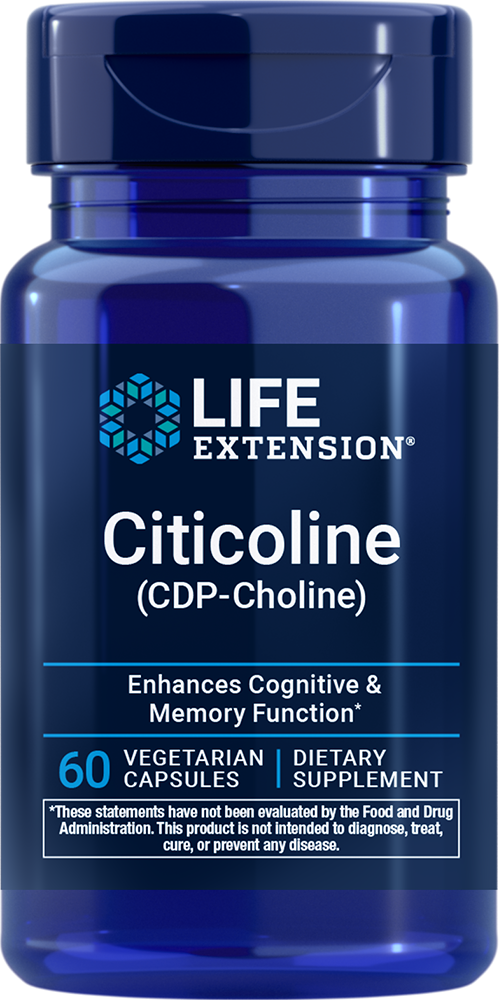
Life Extension’s Citicoline checks the first three boxes cleanly: it names Cognizin® specifically, delivers 500 mg across a two-capsule serving — squarely inside the studied range — and comes from a company that holds NSF GMP registration at the manufacturing level. It skips the stimulant-stacking problem entirely by staying a single-ingredient formula.
A single-ingredient, clearly-dosed Cognizin® citicoline capsule from a long-established, NSF GMP-registered manufacturer — a straightforward, well-sourced pick for the specific population that actually needs more choline, without the stimulant-stacking or proprietary-blend problems common in this category.
FAQs
What’s the difference between citicoline and a basic choline supplement like choline bitartrate?
Choline bitartrate is just a choline salt — cheap, straightforward, and the form most often used to pad out multivitamins. Citicoline (CDP-choline) delivers choline plus cytidine, which your body converts into uridine for membrane repair, and it has a much larger body of human research behind it for memory and cognition specifically. If a product only lists “choline” with no further detail, it’s almost always the basic bitartrate form.
Is citicoline or Alpha-GPC better for focus?
It depends on the goal. Alpha-GPC clears the body faster and has more research in short-term athletic and power-output contexts. Citicoline clears more slowly and has a deeper research base specifically in memory, attention, and age-related cognitive decline. For general brain-health or memory goals rather than a pre-workout boost, citicoline’s evidence base is the more directly relevant one.
Can I just get enough choline from food instead of supplementing?
Yes, if you eat it consistently. Eggs and liver are by far the densest sources, and a couple of whole eggs a day covers a large share of the 425–550 mg daily target. The gap mainly shows up in people who eat few or no eggs, dairy, or meat, and in pregnant or breastfeeding women, whose needs go up while many diets don’t adjust to match.
Are there side effects, or anyone who should be cautious with citicoline?
Citicoline is generally well tolerated in research, with mild and uncommon GI upset being the most frequently reported issue. Because choline feeds directly into the acetylcholine system, anyone pregnant, breastfeeding, or taking medication that affects that system should talk to a doctor before adding a supplement rather than assuming it’s automatically fine to stack on top of a prenatal vitamin or existing prescription.
If you don’t eat eggs, liver, or meat with any regularity, or you’re pregnant, breastfeeding, or specifically chasing a memory-support benefit, choline is one of the more defensible nutrient gaps to actually close with a supplement — but the form matters more here than in most categories, and a vague “choline” listing on a label is usually a sign the product wasn’t built with the research in mind.
As an Amazon Associate, The Health Verdict earns from qualifying purchases. This article is educational and is not medical advice — talk to your doctor before starting any new supplement, especially if you are pregnant, breastfeeding, or taking medication that affects the cholinergic (acetylcholine) system.