Calcium Fructoborate vs. Boron Citrate: Why Boron’s Best Evidence Belongs to Only One Form
Boron has no official daily requirement, was never proven essential, and its most famous claim — that it boosts testosterone — failed its own placebo-controlled test. One specific form of it still has real, if modest, human trial data behind a much narrower claim nothing else in the category can make.
Boron is a trace element present in soil, water, and many plant foods, but unlike calcium or vitamin D it has never been classified as an essential nutrient for humans. The National Institutes of Health’s Office of Dietary Supplements says flatly that there isn’t enough data to set an RDA, an AI, or even an Estimated Average Requirement for boron — the kind of nutrient status usually reserved for things the body can’t function without. That hasn’t stopped it from being marketed as a hormone booster, a bone-support mineral, and a joint-comfort supplement, sometimes all three on the same bottle.
What boron actually seems to do, based on the research that exists, is more diffuse than any one of those claims: animal and limited human studies tie it to calcium and magnesium metabolism, steroid hormone levels, vitamin D status, and markers of inflammation — plausible mechanisms, not settled ones. Once swallowed, nearly all of it — NIH puts absorption at roughly 85 to 90 percent — gets hydrolyzed into boric acid in the gut regardless of which chelate it started as, and the agency says outright that no data exist showing one supplemental form (citrate, glycinate, aspartate, picolinate) is absorbed any better than another.
There’s one exception to that “form doesn’t matter” rule, and it isn’t about absorption at all. Calcium fructoborate — a patented, naturally derived boron-fructose-calcium complex — has its own specific run of small human trials, mostly for osteoarthritis-related joint comfort and inflammatory markers like C-reactive protein. Generic boron citrate or glycinate hasn’t been tested that way; it’s riding on boron’s general, looser evidence base instead. That distinction is the actual subject of this review, because it’s the one place where picking a specific form of boron is a real decision rather than a marketing detail.
Who Actually Needs This
Given that there’s no established requirement, and that NHANES-based estimates put typical adult dietary boron intake around 1 to 1.5 mg a day from ordinary foods — coffee, apples, prunes, raisins, legumes, and potatoes — most people are already getting what research suggests is an adequate amount without supplementing at all. The restriction studies that hint at boron’s role (diets cut to roughly 0.23 to 0.25 mg per 2,000 kcal) describe an intake far below what a typical diet already provides, which argues for not going deficient, not for adding more on top of an adequate baseline.
The people with a plausible reason to consider it are narrower than the marketing suggests: those specifically interested in the joint-comfort angle that calcium fructoborate has actual trial data for, or someone whose diet is unusually low in the foods that supply it. It’s a weaker case for anyone chasing boron’s old reputation as a natural testosterone booster — more on that below — and worth a second look for anyone with a hormone-sensitive condition, since even moderate boron intake has been associated with changes in estrogen levels in some research.

Dosing: What the Research Actually Supports
Because there’s no RDA, dosing guidance here comes from safety limits and trial amounts rather than a target to hit. The World Health Organization has suggested 1 to 13 mg a day as an acceptable range for adults, and the U.S. tolerable upper intake level (UL) set by the National Academy of Medicine is 20 mg a day for adults, including during pregnancy and lactation. The clinical trials behind boron’s joint-comfort claim, nearly all of them using calcium fructoborate specifically, have generally dosed in the 3 to 6 mg a day range — far below the UL, and in line with what a reasonable supplement actually needs to provide.
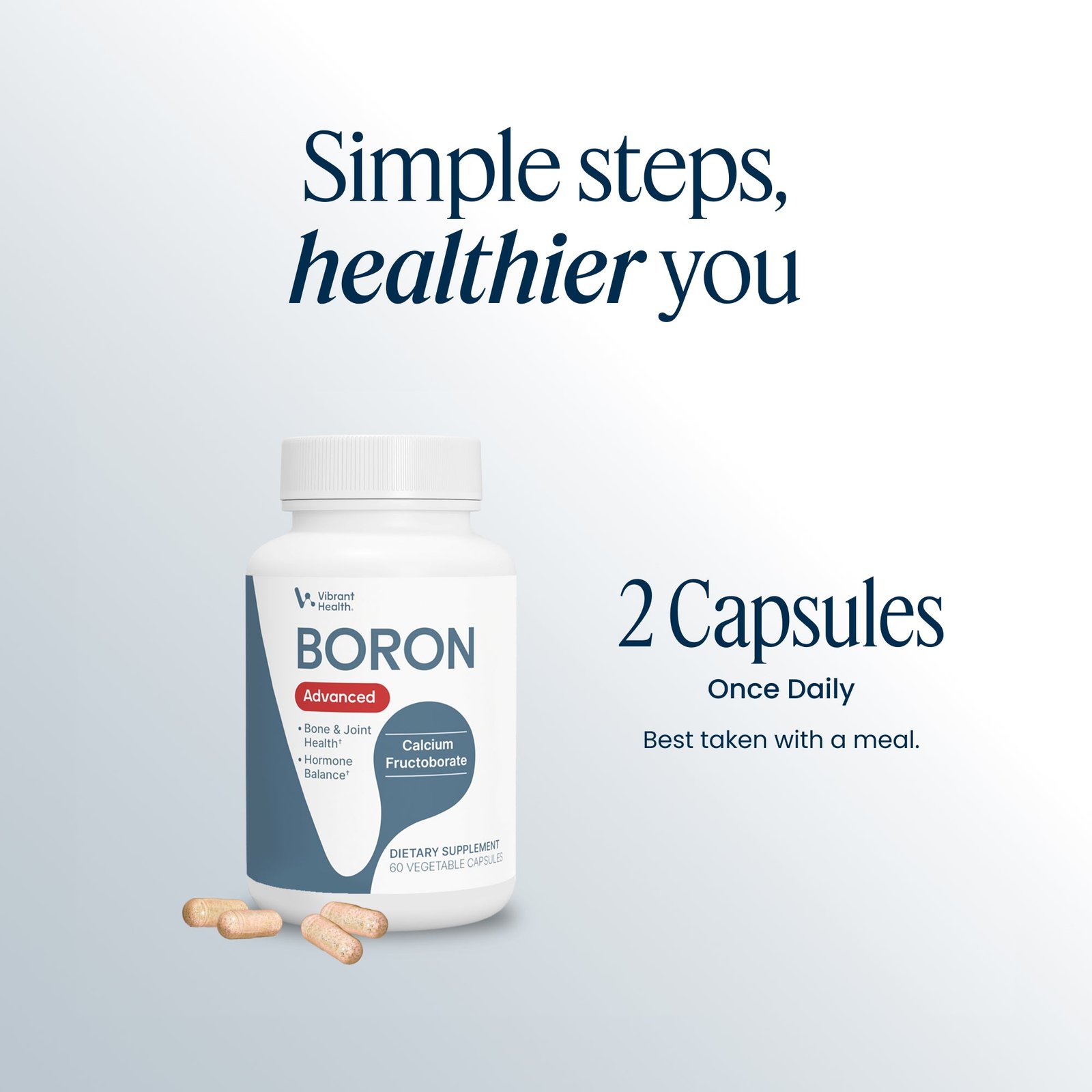
Vibrant Health’s Boron supplies 6 mg of elemental boron as calcium fructoborate per two-capsule serving, which sits squarely inside that studied joint-comfort range and well under the 20 mg adult UL. There’s no research suggesting that pushing boron intake higher than this buys any additional benefit — if anything, the available trials used doses in this same modest range, not multiples of it.

Calcium Fructoborate vs. Boron Citrate: What Changes
Swallow either one and the chemistry converges fast — both end up as boric acid in the gut, absorbed at roughly the same rate, doing whatever boron does systemically regardless of which salt or chelate carried it into the capsule. What doesn’t converge is the research record attached to each. Calcium fructoborate is the specific compound behind the osteoarthritis and inflammatory-marker trials; boron citrate, glycinate, and aspartate are riding on boron’s broader, more general evidence instead. For the “boron helps with bone and hormone metabolism generally” claim, the form genuinely doesn’t matter. For the “this specific product has trial data behind its joint-comfort use” claim, it does — and that’s the one place in this category where reading past the word “boron” to the actual compound name is worth the extra few seconds.
What to Look For in a Boron Product
A few concrete checks, ordered by how often products in this category fail them:
- The label states elemental boron, in a realistic 1–6 mg range. That’s the range both dietary intake and the actual clinical trials fall into; anything marketed as a multiples-higher megadose isn’t backed by data showing it does more.
- If joint comfort is the pitch, the label names calcium fructoborate specifically. A product selling that benefit while listing only generic “boron citrate” or an unnamed chelate is borrowing a claim that belongs to a different compound.
- The product doesn’t lean on the testosterone-boosting claim. That’s the one specific boron claim that’s been tested head-on in a placebo-controlled trial and came back empty — a label built around it is marketing outrunning its own evidence.
- No proprietary blend hiding the actual milligram amount. A company willing to state exactly how much elemental boron is in each capsule, rather than burying it inside an unlabeled “bone complex,” is giving you the information needed to judge the dose at all.
Vibrant Health’s Boron clears most of these cleanly — it states its 6 mg elemental dose plainly, names calcium fructoborate specifically rather than hiding behind a generic “boron” label, and doesn’t make a testosterone claim anywhere on its packaging. Where it comes up short is independent verification: Vibrant Health states its own quality claims (no proprietary blends, no hidden fillers) but doesn’t point to NSF, USP, or any other third-party testing program backing this specific product, so a buyer is trusting the label on the company’s word alone.
An honestly labeled calcium fructoborate supplement dosed in line with the actual joint-comfort research — but boron overall remains an unproven, non-essential nutrient with no third-party testing behind this specific bottle, so it’s a considered pick for a narrow use case, not a default add.
FAQs
Does boron actually boost testosterone?
No. The claim traces back to a small, often-cited study of male bodybuilders from the early 1990s, but the placebo-controlled trial designed to test it directly found no meaningful effect on testosterone, strength, or lean mass. Treat this specific claim as unsupported by the evidence.
Do I need a boron supplement if I eat a normal diet?
Probably not. NHANES-based estimates put typical adult intake from food alone — coffee, dried fruit, legumes, potatoes — around 1 to 1.5 mg a day, and no clearly established human deficiency syndrome for boron exists to argue for supplementing on top of that.
Is calcium fructoborate better absorbed than regular boron?
Not according to available evidence; nearly all boron compounds are hydrolyzed into boric acid in the gut at a similar rate regardless of form. What calcium fructoborate has that generic citrate or glycinate forms don’t is its own specific run of small human trials for joint comfort — a research-history difference, not an absorption one.
Is boron supplementation safe for most people?
At doses under the 20 mg adult upper limit, it’s generally considered low risk, and boron isn’t known to have clinically relevant medication interactions. The one caveat worth flagging: even moderate boron intake has been linked to changes in estrogen levels in some research, worth a conversation with a doctor for anyone managing a hormone-sensitive condition.
If you’re specifically managing joint discomfort and want to try the one boron-related claim with actual small-trial support, a calcium fructoborate product dosed at 3 to 6 mg a day is a reasonable, low-risk thing to test for a few weeks. If you’re hoping boron will move the needle on testosterone, energy, or general hormone balance, the evidence doesn’t back that up — and the money is better spent elsewhere, including on nothing at all, since most people already get what the available research suggests they need from food.
As an Amazon Associate, The Health Verdict earns from qualifying purchases. This article is educational and is not medical advice — talk to your doctor before starting any new supplement, especially if you have a hormone-sensitive condition.