Alpha-Tocopherol Alone vs. Mixed Tocopherols and Tocotrienols: Why Isolating One Form of Vitamin E Backfired in Its Biggest Trial
In 2011, the largest vitamin E prevention trial ever run found that daily use of the single most common form of the vitamin raised men’s prostate cancer risk by 17 percent — and the likely problem wasn’t vitamin E, but isolating one of its eight natural forms from the other seven.
“Vitamin E” on a label almost always means one molecule: alpha-tocopherol. But vitamin E is really a family of eight related compounds — four tocopherols (alpha, beta, gamma, delta) and four tocotrienols carrying the same four names — each built on a slightly different side chain, each doing a different job. Foods genuinely rich in vitamin E, like sunflower seeds, wheat germ, and palm oil, deliver several of these forms at once. Most supplements, and the one major trial that found harm, deliver exactly one.
Even within that one form, there’s a split that matters. Natural-source vitamin E — usually from soybean or sunflower oil, labeled d-alpha-tocopherol — is a single molecular shape, called RRR. Synthetic vitamin E, built chemically from petrochemical precursors and labeled dl-alpha-tocopherol, is a mixture of eight different shapes in roughly equal parts. Per the Linus Pauling Institute’s review of the research, only the shapes with a specific twist at one carbon position — the “2R” configuration — meet the activity standard the human body actually uses; the rest are processed and cleared without doing the job. Converted to usable amounts, a 400 IU label claim works out to roughly 268 mg of functional vitamin E from the natural form, versus only about 180 mg of equivalent activity from the synthetic form at the same labeled dose.
A liver protein called alpha-tocopherol transfer protein is the gatekeeper behind this: it preferentially repackages alpha-tocopherol — especially the natural RRR shape — for release into the bloodstream, while the other tocopherols and all four tocotrienols are mostly cleared. That’s why isolating alpha-tocopherol at high, sustained doses matters — it can crowd the other seven forms out, not just skip them.
Who Actually Needs a Full-Spectrum Vitamin E
Most adults eating a reasonably varied diet already meet the RDA for vitamin E — 15 mg, about 22.4 IU, per day — from nuts, seeds, vegetable oils, and leafy greens, without supplementing at all. People who reach for a supplement anyway are usually doing it for antioxidant or skin support, cardiovascular support, or a diagnosed fat-malabsorption condition — Crohn’s disease, cystic fibrosis, chronic pancreatitis, or a history of bariatric surgery — that genuinely impairs vitamin E absorption from food.
For that malabsorption group, and for anyone taking meaningfully more than food provides for another reason, the research below favors a product that mirrors how vitamin E occurs in food — a mix of forms — over a single high-dose isolate, especially the synthetic one used in the trial that found harm.

The Dose That Backfired — and What a Full Spectrum Looks Like Instead
The SELECT trial (Selenium and Vitamin E Cancer Prevention Trial) enrolled 35,533 men from 2001 to 2008. Its vitamin E arm took 400 IU per day of all-rac-alpha-tocopheryl acetate — the synthetic, isolated form — and after a median of about seven years, researchers reported a statistically significant 17 percent higher rate of prostate cancer versus placebo (Klein et al., JAMA, 2011). It’s one of the only large, randomized, placebo-controlled trials to find a specific harm from a single vitamin E form at a specific dose. A later re-analysis of SELECT’s own blood samples didn’t pin the cause on tocopherol displacement — it flagged a possible interaction with selenium instead, and said plainly that the mechanism remains unresolved. The honest summary: the finding is real and specific to that isolated, synthetic, years-long exposure — the exact “why” isn’t settled science.
Separately, and on firmer ground, human intervention studies show that supplementing with alpha-tocopherol alone measurably lowers blood levels of gamma- and delta-tocopherol — forms your body would otherwise carry from food (Huang & Appel, 2003). Those aren’t inert filler: gamma-tocopherol and the tocotrienols are believed, from laboratory research, to neutralize different classes of free radicals than alpha-tocopherol does, though large human outcome trials isolating those effects are still limited. A product disclosing real milligram amounts of gamma-tocopherol, delta-tocopherol, and tocotrienols alongside natural d-alpha-tocopherol is, at minimum, avoiding the one-isomer displacement pattern that SELECT’s isolated dose represents.

Alpha-Tocopherol Alone vs. Alpha + Gamma + Delta + Tocotrienols: What Changes
Swapping an isolated 400 IU synthetic alpha-tocopherol capsule for a natural full-spectrum product changes three measurable things: the stereochemistry (all active RRR shape instead of a racemic mix where roughly half the molecules miss the human activity standard), the usable vitamin E delivered per labeled IU (about 268 mg versus roughly 180 mg of functional equivalent), and the presence of gamma-tocopherol, delta-tocopherol, and tocotrienols you’d otherwise be short of while megadosing one isomer. None of this proves a full-spectrum product is protective where SELECT’s isolated dose was linked to harm — that comparison hasn’t been run at SELECT’s scale — but it isn’t replicating the specific exposure that produced the signal, either.
What to Look for in a Full-Spectrum Vitamin E Product
“Vitamin E complex” and “mixed tocopherols” are loose enough terms that a bottle can carry either phrase while still delivering almost entirely alpha-tocopherol. Four things separate a genuinely full-spectrum product from a relabeled alpha-tocopherol capsule, ordered by how often products fail them.
- Natural source, not synthetic. The label should say d-alpha-tocopherol or RRR-alpha-tocopherol, not dl-alpha-tocopherol or “all-rac” — the single most common shortcut, since synthetic vitamin E is cheaper to manufacture.
- Gamma- and delta-tocopherol disclosed in milligrams. A product can legally say “mixed tocopherols” while the gamma and delta content amounts to a few milligrams — present on the label, biologically negligible.
- Tocotrienol source and amount stated, not implied. When a label leans on the word “complex” without a milligram figure or a named source like palm or annatto oil, there’s often little or none actually present.
- Independent third-party verification of potency and purity. NSF Certified for Sport, USP Verified, or an equivalent confirms an outside lab checked that the bottle matches the label — a step most vitamin E products skip.
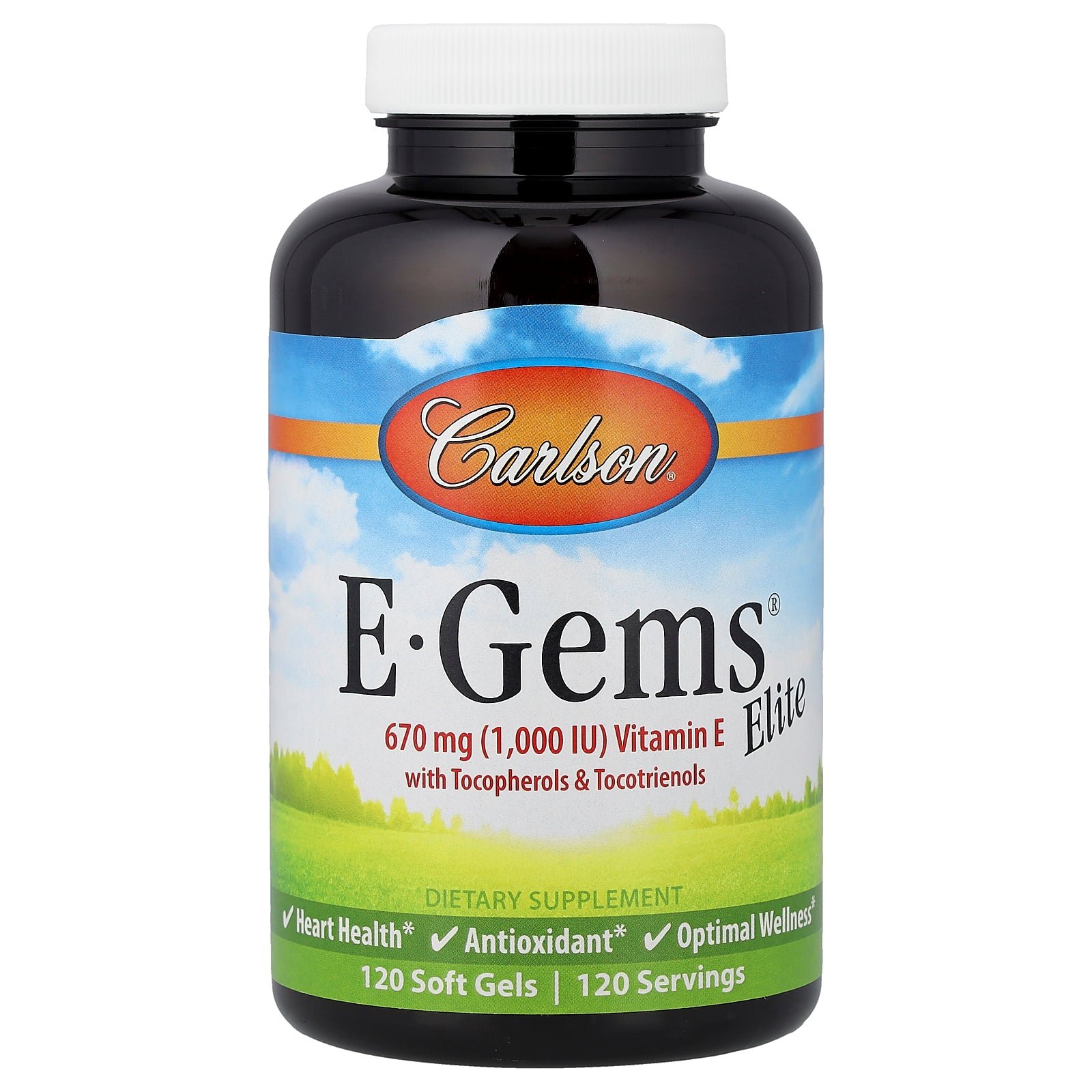
Carlson E-Gems Elite clears the first three cleanly: it’s labeled as natural-source d-alpha-tocopherol (268 mg per softgel, from a 400 IU dose), and it discloses real amounts of the rest of the family — 100 mg of d-gamma-tocopherol, 40 mg of combined d-beta- and d-delta-tocopherol, and 20 mg of total tocotrienols sourced from palm fruit oil. Where it falls short is the fourth bar: we found no NSF, USP, or Informed Sport certification for this specific product, only the brand’s own claim of being “independently assayed to guarantee potency” — a real step, but not the same as a named, outside certifying body.
A genuinely full-spectrum, natural-source vitamin E that discloses real milligram amounts of gamma-tocopherol, delta-tocopherol, and tocotrienols — held back from a clean recommendation only by the absence of independent third-party potency verification.
FAQs
Is synthetic vitamin E (dl-alpha-tocopherol) actually dangerous?
No single study shows synthetic vitamin E is toxic at typical multivitamin-level doses. SELECT’s 17 percent higher prostate cancer rate was specific to 400 IU per day of the isolated synthetic form, taken for a median of about seven years by men 50 and older — and researchers still haven’t settled on why. The pattern worth avoiding is isolated, high-dose, long-duration — not the word “synthetic” by itself.
Do I need tocotrienols specifically, or are mixed tocopherols enough?
Tocotrienols have their own research base, mostly around cholesterol and neuroprotection, but they clear the body faster, so their real-world benefit at a standard supplemental dose is less firmly established than tocopherols’. Mixed tocopherols alone (alpha, gamma, and delta together) already address the one-isomer displacement problem described above; tocotrienols are a reasonable addition, not a requirement.
Should I stop taking my current vitamin E supplement?
Don’t stop anything a doctor prescribed without asking first. But check your label: an isolated dl-alpha-tocopherol product at 400 IU or more, taken daily for months or years — especially if you’re an older man — is the specific pattern this article covers, and worth a conversation with whoever recommended it.
What’s the actual recommended dose, and am I probably getting enough from food?
The RDA for adults is 15 mg, about 22.4 IU, per day. Most people eating nuts, seeds, vegetable oils, and wheat germ meet that without supplementing. Going meaningfully above it should have a specific reason — a diagnosed deficiency or malabsorption condition — rather than being a default daily habit.
This matters most for anyone already taking, or considering, a high-dose isolated vitamin E supplement — 400 IU or more daily — for months or years at a time, particularly older men in the age range SELECT studied. For most people eating a reasonably varied diet, the practical takeaway is simpler: there’s little reason to reach for an isolated alpha-tocopherol megadose by default, and if you do supplement, a natural-source, full-spectrum product that discloses real gamma-tocopherol, delta-tocopherol, and tocotrienol amounts is the more food-like choice — with the one gap here being that no independent lab certification could be confirmed for this particular product.
As an Amazon Associate, The Health Verdict earns from qualifying purchases. This article is educational and is not medical advice — talk to your doctor before starting any new supplement, especially if you take warfarin or another blood thinner, since vitamin E has mild antiplatelet activity at higher doses.